


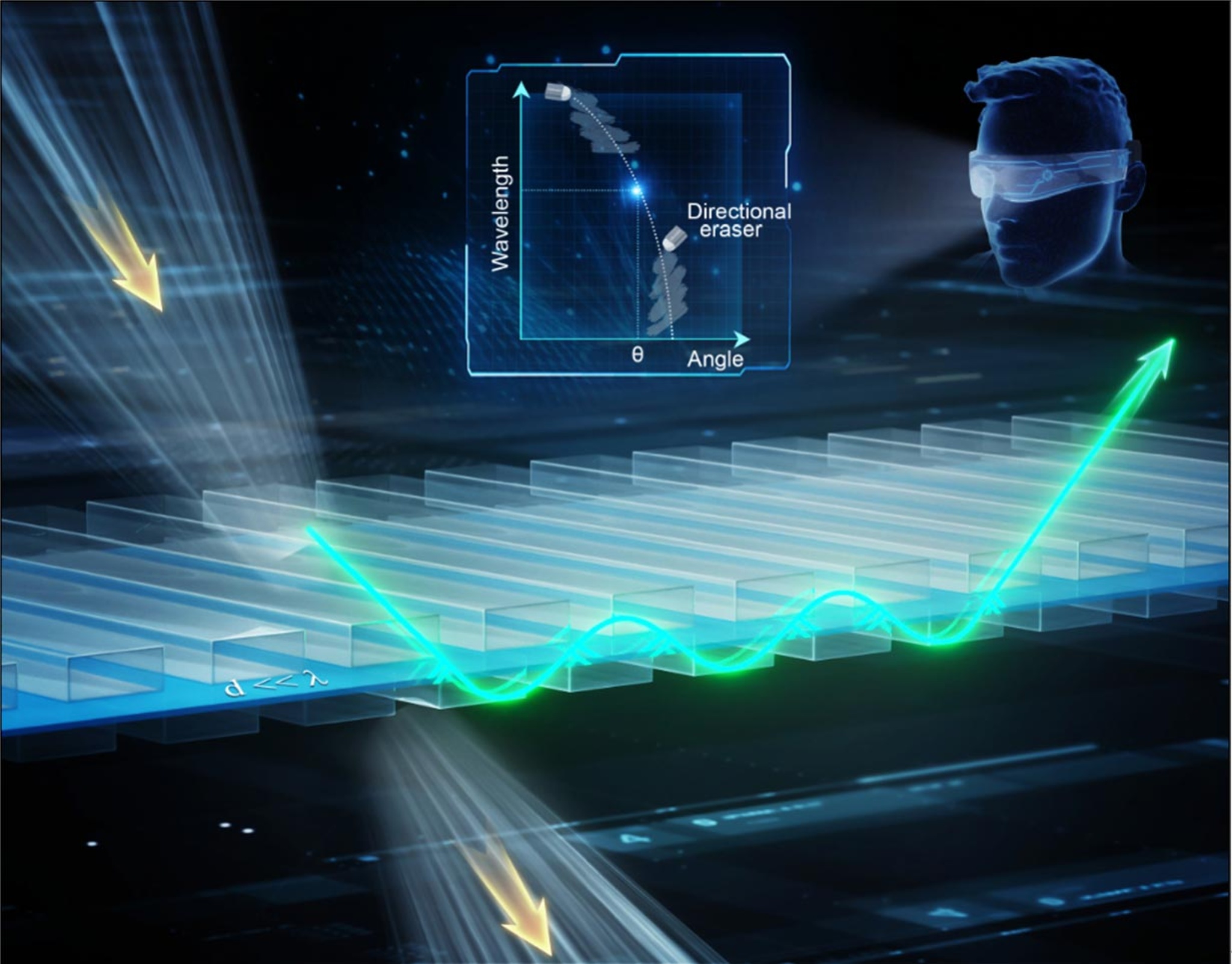
Scientists have developed a revolutionary imaging method that challenges long-standing limits in optical science, achieving ultra-sharp, wide-field resolution without the use of traditional lenses or painstaking physical alignment. This innovation could transform how optical systems are designed and used across science, technology and everyday applications.
Rethinking Optical Limits
For decades, optical imaging has been bound by fundamental physical constraints: to obtain high resolution, lenses must be large, precisely aligned and close to the subject. These requirements have restricted fields such as microscopy, remote sensing and industrial inspection, where balancing resolution with practicality has been a persistent challenge.
The new approach sidesteps those limitations by capturing raw light patterns through multiple independent sensors and using advanced computational methods to synchronise and merge the data. Rather than relying on lenses to focus light, the system reconstructs high-resolution images directly from diffraction patterns — the way light spreads after interacting with objects.
A Software-First Imaging Paradigm
At the core of this breakthrough is a technique known as Multiscale Aperture Synthesis Imaging (MASI). Inspired by advances in radio astronomy, where arrays of telescopes are coherently combined to create powerful virtual apertures, MASI applies similar principles to visible light using computation rather than precise physical alignment.
Each sensor records how light waves behave at different locations. Sophisticated algorithms then synchronise and optimise these patterns after the fact, effectively creating a virtual aperture that can exceed the resolution of any single device. The outcome: sub-micron detail across a wide field of view — a level of clarity previously unobtainable without bulky optics.
Why It Matters
By replacing physical constraints with computational power, this imaging framework opens new possibilities:
- Microscopy without traditional lenses: Researchers could observe cellular and molecular processes in unprecedented detail without complex optical setups.
- Industrial and forensic inspection: Surfaces, defects and microstructures could be examined with higher precision across large areas.
- Remote sensing and diagnostics: High-resolution imaging could be conducted from greater distances or in environments where optical hardware is impractical.
The technology’s flexibility also means it can scale — unlike traditional optical systems, which become exponentially more complex as resolution increases. MASI’s computational underpinning allows for linear expansion, potentially enabling large, flexible sensor arrays suited to diverse applications.
From Research to Real-World Impact
The team behind this innovation emphasises that the computational shift doesn’t just improve image quality — it redefines how imaging systems can be built and deployed. By decoupling resolution from lens design, scientists and engineers can rethink everything from digital medical diagnostics to autonomous vehicle perception systems.
This breakthrough also highlights the growing synergy between advanced computation and physical science. As algorithms become more powerful and accessible, they can solve problems once thought limited by the laws of physics alone.
Looking Ahead
While still in its early stages, this new imaging paradigm points toward a future where ultra-high-resolution optical systems are more compact, adaptable and capable than ever. For industries spanning healthcare, manufacturing, science and beyond, the ability to see more — with fewer physical constraints — could unlock discoveries and efficiencies that reshape their fields.