


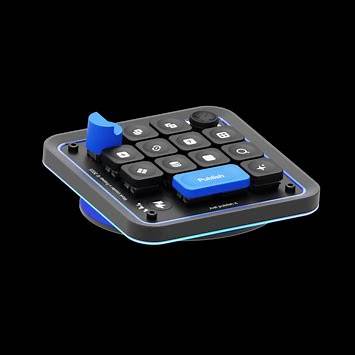
In a tech industry obsessed with moonshot devices, AI wearables and futuristic assistants, OpenAI’s next hardware tease is refreshingly, gloriously specific.It is not a face computer. It is not a voice orb. It is not some mysterious screenless personal companion from the future. Instead, it appears to be a compact mechanical macro pad built with Work Louder, aimed squarely at developers using Codex.
And honestly, that may be exactly why it is so interesting.
Set for a full reveal on July 15, the teased device looks like a tiny slab of programmable productivity, the sort of desk accessory that would make perfect sense to anyone who spends all day inside terminals, editors and AI coding tools. It is niche, unapologetically tactile and deeply targeted at a very online kind of workflow. In other words, it feels less like a mass-market gadget and more like a piece of hardware designed for people who genuinely care about shaving friction out of the act of building.
“The most interesting AI hardware is not always the most futuristic. Sometimes it is simply the device that makes daily work feel better.”
What OpenAI has revealed so far is minimal but suggestive. The company has teased that “your favorite Codex shortcuts are getting an upgrade,” which strongly implies a physical input device built around the actions developers use most often while working with Codex. That could mean quick-access prompts, approval flows, rewrite commands, run actions or other common coding shortcuts translated into something far more tactile than a keyboard combination buried in muscle memory.
That idea alone makes the product more intriguing than it may sound at first glance.
Mechanical keyboards and macro pads have long occupied a special place in creative and developer culture because they do something software alone often cannot: they turn routine actions into physical habits. Pressing a dedicated key, twisting a knob or flicking a joystick can feel faster, more reliable and strangely more satisfying than relying entirely on standard shortcuts. It makes repetitive work feel a little less abstract and a little more intentional.
That is where Work Louder’s involvement becomes especially important.
The company has built a reputation for stylish, creator-focused hardware that blends utility with strong industrial design. Its existing Creator Micro 2 offers the kind of layout that seems almost purpose-built for this sort of collaboration: a compact array of programmable keys, multiple shortcut layers, a joystick-driven radial menu and a dial for extra control. It is the kind of hardware that already appeals to people who want their desk setup to be both more beautiful and more functional.
If OpenAI is indeed adapting that formula for Codex, the company is doing something surprisingly smart. Rather than trying to invent an entirely new hardware category, it appears to be taking an already-loved niche format and tuning it for a specific AI workflow.
That is a far more grounded and arguably far more useful approach than many recent AI hardware experiments.
“Instead of asking users to change how they work, this device appears to meet them where they already are, at the desk, inside the workflow, hands on the keys.”
There is also something culturally telling about this launch.
AI has spent the past two years trying to prove it belongs everywhere, in every app, every operating system and every consumer device imaginable. Much of that expansion has been framed in broad, often vague language about transformation and intelligence. This hardware tease feels different. It is not trying to convince everyone. It is aimed at a very particular audience, developers and technical users who already live inside the tools OpenAI is building.
That specificity may be its biggest strength.
For the people likely to buy something like this, the appeal is not that it looks futuristic. It is that it looks useful. A dedicated Codex control surface could reduce friction, speed up common actions and make AI-assisted development feel more immediate. Even if the practical gains are modest, the tactile experience itself matters. Good tools are not only about efficiency. They are also about rhythm, confidence and flow.

The design language matters too.
Work Louder’s products have always leaned into the idea that productivity hardware should feel expressive rather than sterile. Clear shells, soft underglow, tactile keys and playful controls give its devices a sense of personality that stands apart from conventional office accessories. That aesthetic makes a lot of sense for a Codex collaboration. AI coding culture has become deeply visual, highly personalised and intensely desk-centric. This kind of hardware fits naturally into that world.
It also gives OpenAI something it has not really had in hardware before: physical presence on the desk.
That may sound small, but it is symbolically significant. Until now, OpenAI has largely existed through chat windows, developer tools and cloud services. A Codex macro pad would be a tangible expression of the company’s push into daily workflow, not just as software running in the background, but as something you physically reach for.
“If software is where AI lives, hardware is where it starts to become part of habit.”
There is, of course, a limit to how much should be assumed before launch. OpenAI has not yet confirmed the final feature set, exact layout, compatibility model or price. It is entirely possible that the finished product will be more limited, more experimental or more niche than the current excitement suggests.
But even at the teaser stage, the concept already says something important about where AI tooling may be heading next.
The real future of AI hardware may not begin with mysterious all-purpose companion devices. It may begin with highly specific, deeply practical tools designed to improve one workflow at a time. A macro pad for Codex may not sound revolutionary in the grandest sense, but it could end up being one of the more believable examples of AI hardware actually making sense in the real world.
[Embed another product shot or Work Louder-style macro pad image here]
In that sense, this launch feels oddly mature. It does not appear to be trying to replace the laptop, the phone or the keyboard. It is trying to enhance the way a certain group of users already works. That is a much more achievable ambition, and perhaps a much more interesting one too.
Final Thoughts
OpenAI’s teased mechanical keyboard “thingy” may be one of the year’s most unexpectedly compelling hardware stories, not because it is enormous in ambition, but because it is so focused. A Codex-first macro pad built with Work Louder would represent a different kind of AI device, one built around workflow, tactility and everyday usefulness rather than spectacle.
If the final product delivers on that promise, it could become exactly the sort of desk accessory developers did not know they needed until they saw it. And in a market crowded with AI hardware concepts that often feel abstract or overdesigned, that kind of practical clarity could be its biggest advantage.