


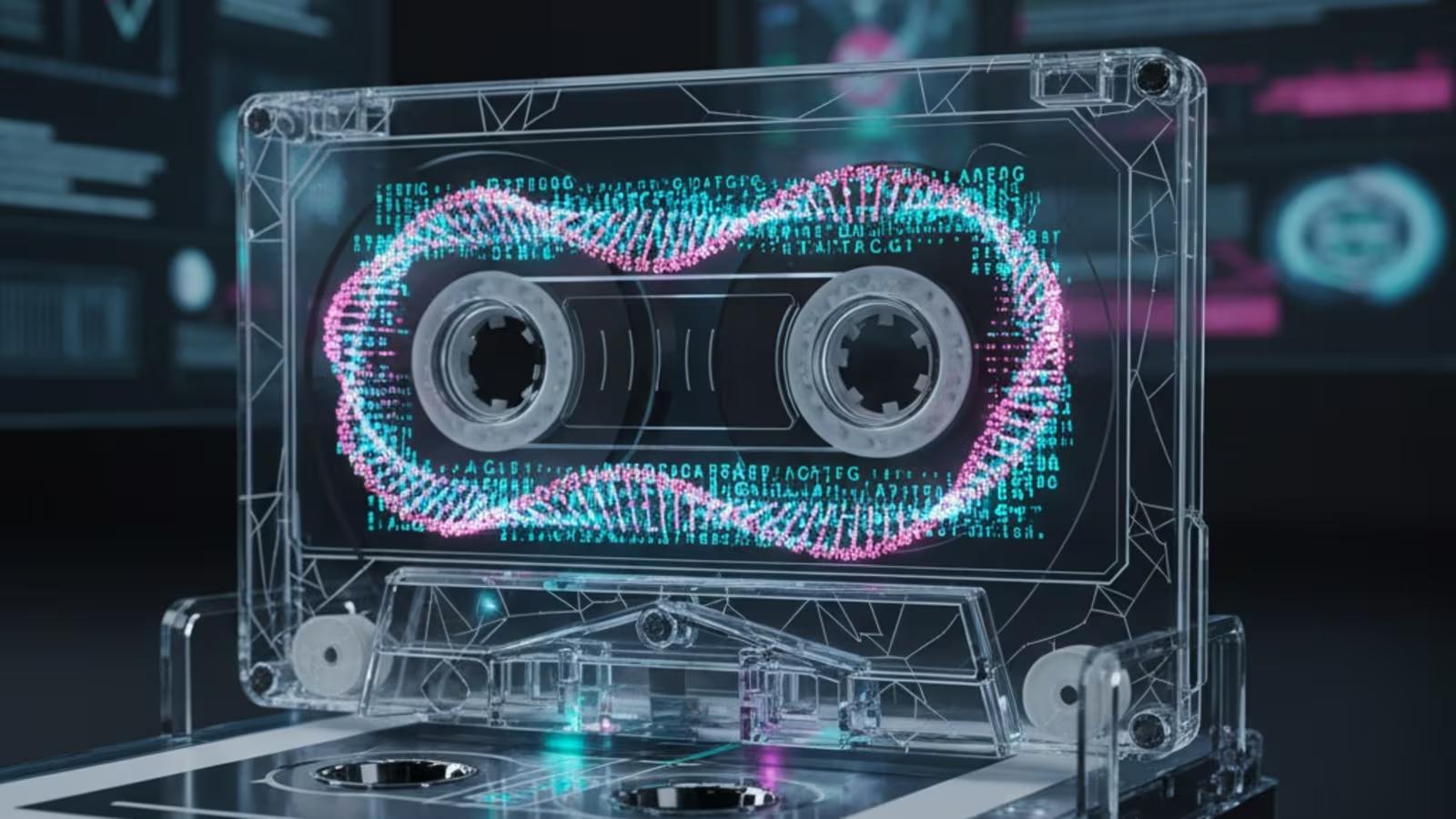
Imagine your favorite mixtape—but instead of rewinding magnetic tape, you’re decoding molecules. That’s what a team of scientists in China has created: a “DNA cassette tape” so dense, it could theoretically store every song ever recorded. It’s like vinyl, nostalgia, and sci-fi rolled into one extremely futuristic project.
How It Works: Cassette Meets Code
This isn’t your Walkman-friendly cassette. It looks like one, but inside the plastic—on a polyester-nylon ribbon—scientists have embedded synthetic DNA. The four base pairs of DNA (A, T, C, G) are used like the ones and zeroes in your computer files. Songs, photos, whatever you can digitalize—they’re translated into DNA sequences, printed onto the tape, and “stored” there.
To make it more usable, the tape has barcode markings. Think of them like folders or chapters in a big library: each barcode points to a specific partition of data, which helps the system find the exact spot to load what you want. And to protect all that precious molecular information, the ribbon is coated in a “crystal armour” that shields the DNA from environmental damage—light, moisture, etc.—so the data could survive for centuries.
What It Can Hold: Wild Numbers
Here’s where things get wild:
- The tape’s prototype capacity is about 36 petabytes. To give that some context: that’s equal to tens of thousands of regular terabyte hard drives stacked together.
- It can store over 3 billion songs if you assume each file is about 10 megabytes.
- Just 100 meters of this tape could hold data that dwarfs conventional storage media.
In short, we’re talking archival levels of storage. This kind of tech is aimed at “cold” data—stuff you want to keep for ages but don’t necessarily access every day.
What We’re Still Figuring Out
It’s not all perfect yet. Some challenges remain:
- Speed: Reading, writing, retrieving—these processes are currently slow. The prototype takes a long time to recover even small files.
- Cost & scaling: Producing synthetic DNA and sequencing it is expensive. Scaling up to where this becomes usable for businesses or home-users will be an investment.
- Practicality: You won’t plug this into your tape deck. It needs special “cassette drives” that can handle DNA workflows and barcode scanning.
Why It’s Exciting
Because this could shift how we think about data storage altogether. Hard drives age, tapes deteriorate, cloud services use tons of energy. DNA storage promises enormous density, durability, and lower maintenance—once the costs settle and the speed improves.
It’s the sort of tech that feels like something out of a cybertin tale, but it’s moving quickly from lab fantasy toward potential utility. If nothing else, it’s a reminder that sometimes the solutions to tomorrow’s drama are hidden in ancient biology.
Final Thoughts
We might still be years away from storing our music libraries on DNA tapes at home. But this development feels less like wild speculation, more like the first chapter of a storage revolution. For fans of music, archiving, and futuristic ideas—it’s thrilling to watch.