


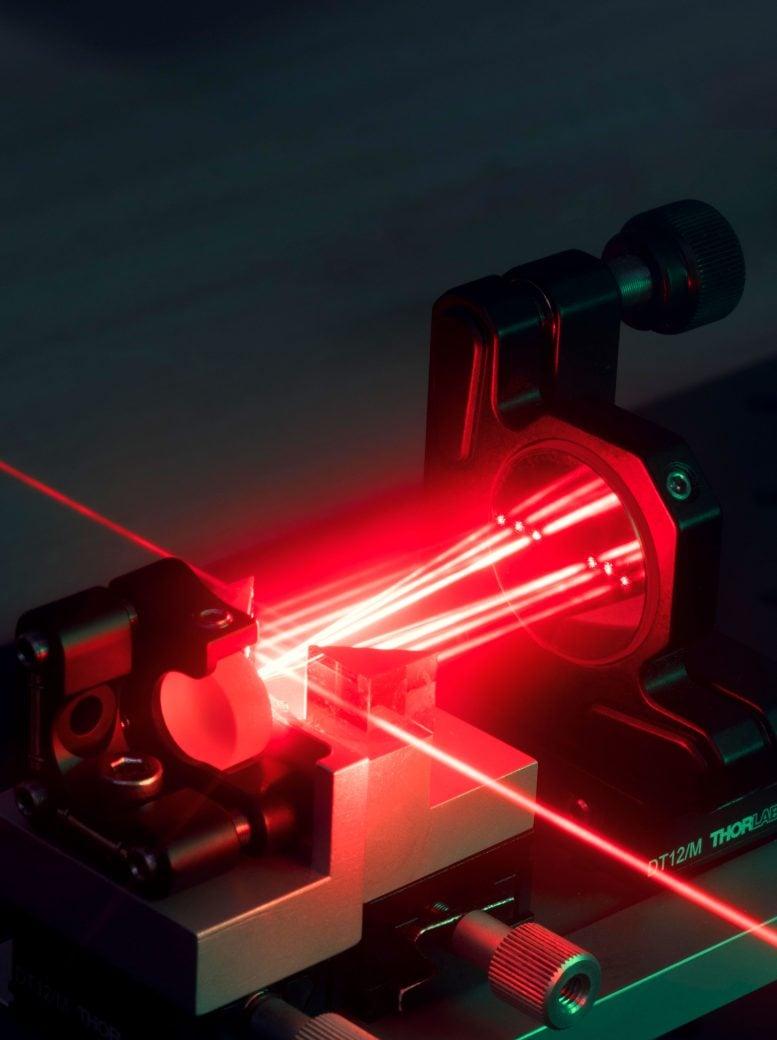
Researchers at University of Stuttgart, in collaboration with Stuttgart Instruments GmbH, have developed what could be a pivotal leap in laser technology: a compact, palm-sized, high-efficiency short-pulse laser system that promises to reshape applications in manufacturing, medicine and scientific instrumentation.
What has been achieved
Short-pulse lasers—those producing bursts of light in nano-, pico- or femto-seconds—are already invaluable for tasks demanding extreme precision. These tasks span ultra-fine machining, medical imaging and fundamental research. Yet traditionally, high-power, broadband, short-pulse lasers have required bulky, complex and expensive setups.
The new system solves several of those obstacles:
- It fits into a few square centimetres, with just five key components, making it far more compact than conventional systems.
- It achieves a reported efficiency of up to 80 %—more than double that of many current designs that typically reach about 35 %.
- It uses a novel “multipass optical parametric amplifier” configuration: a short crystal through which pulses are passed multiple times, maintaining bandwidth and synchronisation without needing an unwieldy assembly of long crystals.
Why this matters
The combination of compact size and high efficiency opens new possibilities across sectors:
- Manufacturing: High-precision machining, for example micro-texturing or delicate component fabrication, becomes more accessible and portable. A smaller laser system means integration into tighter spaces or near-production-line setups.
- Medicine and diagnostics: In medical imaging or surgical tools, a compact, efficient laser could lead to devices that are less cumbersome, more mobile and potentially more affordable. The ultra-short pulses can enable novel imaging modalities or even new therapeutic approaches.
- Scientific research and sensing: For applications in spectroscopy, quantum sensing or environmental monitoring, the ability to deliver ultrashort pulses in a compact form expands where and how the technology can be deployed—perhaps even field-based or mobile labs.
Key technical breakthroughs
The major hurdles resolved in this work include:
- Bandwidth vs efficiency trade-off: Previously, amplifiers that offered wide bandwidth (needed for very short pulses) tended to be inefficient, while those that were efficient had narrow bandwidths. The new system breaks that trade-off via its multipass architecture.
- Compactness: By reducing the size of the optical components and passing pulses multiple times through a short crystal, the physical footprint shrinks significantly without compromising performance.
- Pulse duration: The reported system generates pulses shorter than 50 femtoseconds, which is significant performance for such a compact system.
Potential challenges and next steps
While the breakthrough is promising, some caveats should be borne in mind:
- Engineering into products: Moving from lab demonstration to commercial devices often entails scaling of reliability, cost‐efficiency, heat management, ruggedisation, regulatory approval (in medical cases) and integration into existing workflows.
- Use-case validation: To translate the technology into real‐world impact, partners in manufacturing, medical device companies or instrumentation firms will need to validate the system’s advantages (size, cost, power, reliability) in end-use environments.
- Cost and supply-chain: Achieving mass manufacturing of the crystals, precision optics and control electronics may add cost; the economic advantage must hold for widespread adoption.
- Regulatory/medical approvals: In the medical domain especially, any device using this laser will require rigorous clinical testing, regulatory clearance and demonstration of safety and efficacy.
Broader implications
The innovation highlights several important trends:
- The ongoing miniaturisation of advanced photonics means that technologies once confined to large laboratories or specialist facilities may soon become embedded into broader applications.
- Efficiency gains (moving from ~35% to ~80%) mean less wasted energy, smaller power supplies and lower cooling requirements—important in both manufacturing and medical settings where footprint, cost and energy use matter.
- Flexibility in wavelength tuning, pulse duration and form factor means one platform could serve multiple sectors rather than bespoke solutions for each case. The researchers point to adaptability to different crystal systems, wavelengths and pulse durations.
Conclusion
This palm-sized, high-efficiency short-pulse laser represents a strong candidate for “technology that enables the next generation” of applications in manufacturing, medicine and research. By combining compact dimensions with performance levels previously reserved for large systems, it opens doors to innovation in places and ways that were previously impractical.
For sectors seeking to embed advanced optical capabilities—whether to process delicate components, enable new diagnostic tools, or deploy mobile sensing units—this development warrants serious attention. The journey from this lab demonstration to widespread commercial deployment remains ahead, but the potential is striking.