


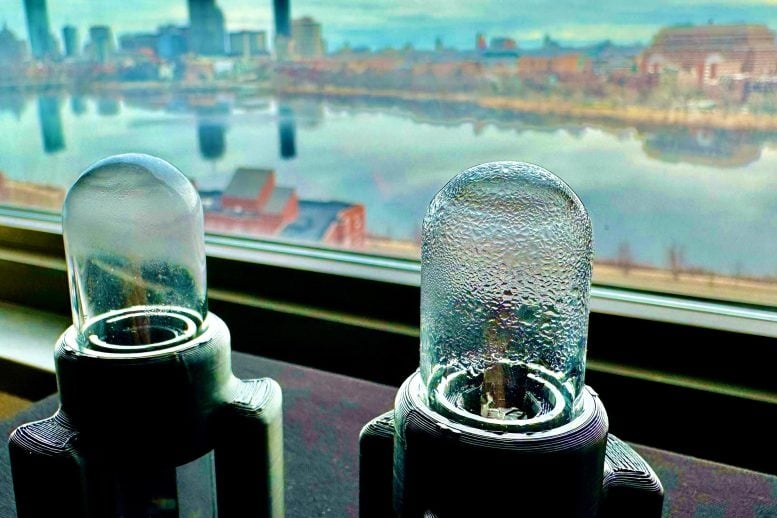
Researchers at the Massachusetts Institute of Technology (MIT) have unveiled a breakthrough ultrasonic device capable of extracting drinking water from the air far more rapidly and efficiently than existing atmospheric-water-harvesting technologies. By replacing slow, heat-driven dehydration methods with high-frequency vibrations, the innovation could pave the way for compact, low-power water-generation systems suited to remote and arid environments.
A New Approach to Water Harvesting
Traditional atmospheric-water-harvesting systems rely on heating sorbent materials to release captured moisture — a process that can take anywhere from tens of minutes to several hours. MIT’s new device dramatically accelerates this release cycle.
The system works by placing a water-absorbing material onto a ceramic ultrasonic actuator. When activated, the actuator vibrates at extremely high frequencies, mechanically shaking water molecules loose from the sorbent. These vibrations break the weak bonds holding moisture in place, causing droplets to form and collect in minutes rather than hours.
Early tests show the release process to be dozens of times more efficient than comparable heat-based systems, opening the door to water-production cycles that can run multiple times per day using only minimal energy.
Why This Innovation Matters
Access to clean drinking water remains one of the most urgent global challenges, particularly for regions affected by drought, unstable infrastructure or climate-driven water scarcity. Conventional harvesting systems often struggle with:
- Long dehydration times
- Heavy reliance on heat or direct sunlight
- High energy demand
- Limited performance in low-humidity environments
MIT’s ultrasonic approach solves some of the biggest bottlenecks by offering:
- Rapid release cycles
- Low-power operation
- Greater flexibility in different climates
- Potential for fully off-grid operation using small solar sources
This could make atmospheric water harvesting far more viable in real-world settings, from rural villages to disaster-response zones.
Inside the Technology
The core of the system is a flat ceramic actuator that produces ultrasonic waves:
- The sorbent absorbs water vapour naturally from the air.
- Ultrasonic vibrations agitate the material, detaching water molecules.
- A shaped collector around the device helps droplets form quickly and efficiently.
- Because the system relies on acoustics rather than heat, it avoids the energy losses and slow evaporation of traditional methods.
The researchers believe the design can easily be paired with small solar cells, making it suitable for portable or stationary units in off-grid scenarios.
Barriers to Overcome
As with any emerging technology, several steps remain before widespread deployment:
- Scaling up throughput: Current tests use small sorbent samples; larger modules will require new engineering.
- Cost and manufacturing: The actuator and sorbent must be produced at scale while keeping units affordable.
- Durability: The components must withstand repeated cycles in hot, humid, dusty or remote conditions.
- Integration: Complete systems will need filtration, storage, and user-safe output for potable water.
Nonetheless, the promise is significant — especially for communities without reliable access to traditional water sources.
A Glimpse Into the Future of Water Access
MIT’s ultrasonic water-harvesting device represents a major step forward in making atmospheric water extraction faster, cleaner and more accessible. If further development proves successful, it could shift the field from niche experimentation to practical, deployable solutions that operate with minimal infrastructure.
For regions grappling with water scarcity, the ability to generate drinking water “from thin air” — efficiently and repeatedly — could be transformative.