


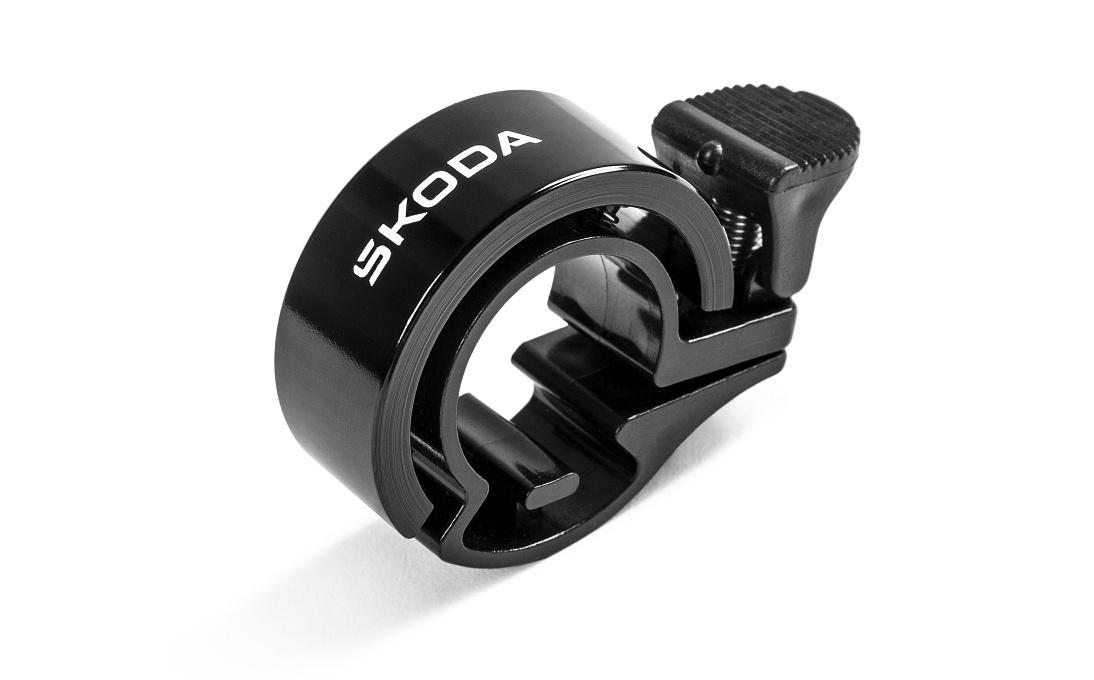
In an era dominated by digital innovation, Škoda’s latest breakthrough is strikingly simple. The DuoBell, a redesigned bicycle bell, addresses a modern safety issue created not by cyclists, but by technology itself: the rise of active noise-cancelling headphones. As urban environments become increasingly saturated with pedestrians wearing ANC devices, traditional warning signals, including the standard bike bell, are no longer reliably heard.
Rather than turning to complex electronics, Škoda has taken a different approach. The DuoBell is entirely mechanical, an analogue solution engineered to outsmart digital algorithms. Developed in collaboration with researchers from the University of Salford, it reflects a deeper understanding of how sound, behaviour, and technology now intersect on city streets.
Engineering Sound That Cannot Be Ignored

The innovation lies in precision. Through acoustic research, engineers identified a narrow frequency band, between 750 and 780 Hz, that active noise-cancelling systems struggle to suppress, a so-called “safety gap.” The DuoBell is tuned specifically to operate within this range, allowing its sound to penetrate headphones that would otherwise block ambient noise.
But frequency alone is not enough. The bell incorporates a second resonator tuned to a higher pitch, alongside a specially designed hammer mechanism that produces rapid, irregular strikes. This combination creates sound waves that are harder for ANC algorithms to predict and cancel, effectively bypassing the technology entirely.
The result is not louder noise, but smarter noise, engineered to be heard where it previously could not be.
Measurable Impact in Real-World Conditions
What elevates the DuoBell beyond concept is its real-world performance. Testing conducted in urban environments, including trials with delivery riders in London, demonstrated a significant improvement in pedestrian awareness. Individuals wearing noise-cancelling headphones were able to detect approaching cyclists up to five seconds earlier and at distances extending roughly 22 metres further than with a conventional bell.
In dense city environments, that margin is critical. It transforms near-misses into avoidable situations, offering both cyclists and pedestrians additional time to react. As urban cycling continues to rise, particularly in cities like London where cyclist numbers are rapidly increasing, this type of incremental improvement carries disproportionate value.
Rethinking a Century-Old Design
Perhaps the most striking aspect of the DuoBell is how little it changes, and how much it redefines. The bicycle bell has remained largely unchanged for over a century, a simple, reliable tool that until recently required no reinvention. But the environment around it has evolved.
The widespread adoption of ANC headphones has effectively created a new form of sensory isolation, where pedestrians move through cities partially disconnected from their surroundings. The DuoBell responds not by adding complexity, but by adapting the fundamentals of sound design to this new reality. It is a reminder that innovation does not always mean adding more technology. Sometimes it means understanding existing technology well enough to work around it.
Open Innovation for Safer Cities
In a move that reflects the broader intent behind the project, Škoda has chosen not to commercialise the DuoBell in the traditional sense. Instead, the company is making its research publicly available, encouraging wider adoption and further development across the cycling industry.
This decision positions the DuoBell less as a product and more as a principle, a shared solution to a growing urban challenge. It also aligns with a wider shift towards open innovation, where safety and public benefit take precedence over proprietary advantage.
A Small Device, A Larger Shift
What the DuoBell ultimately represents is not just a smarter bicycle accessory, but a subtle shift in how we think about urban mobility. As cities become more complex, shaped by overlapping technologies and behaviours, even the simplest tools must evolve.
The future of safety will not be defined solely by large-scale infrastructure or digital systems, but by small, intelligent interventions that adapt to how people actually live and move.
In that sense, the DuoBell is more than a bell. It is a reminder that sometimes the most effective innovations are the ones that quietly solve problems we did not fully realise we had.