


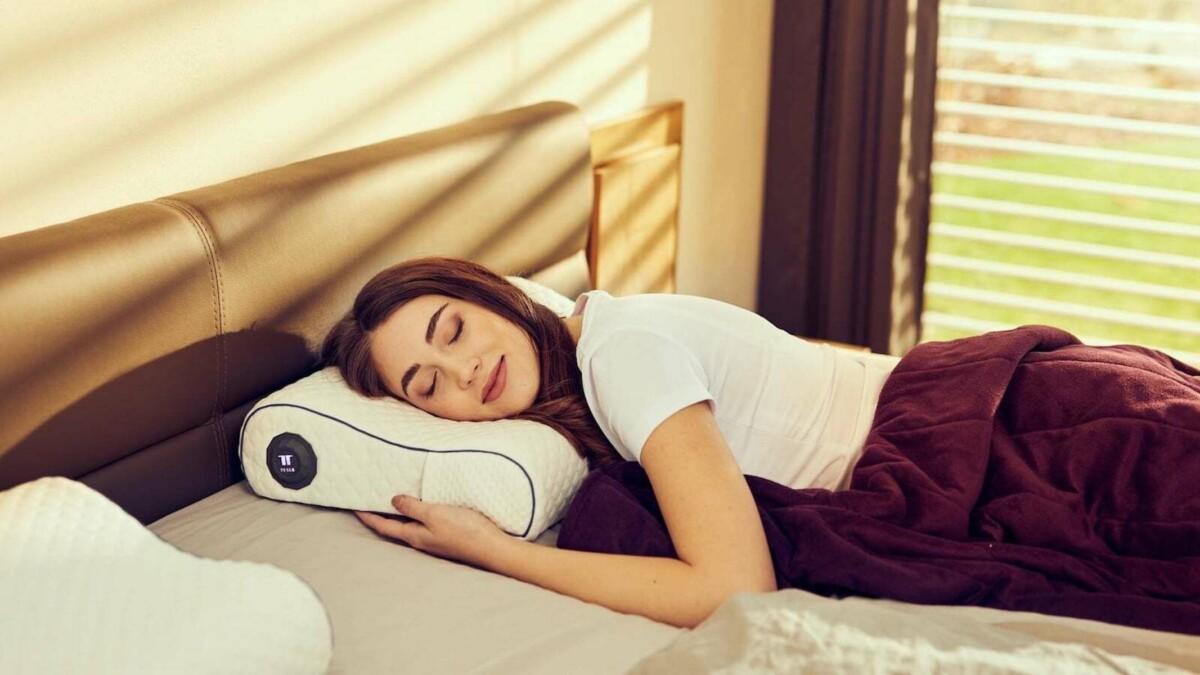
There’s something quietly clever about this idea. Instead of making alarms louder, brighter, or more intrusive, it changes where you feel them. This smart pillow—still in prototype form—doesn’t rely on sound at all, but wakes you through touch. Developed by researchers at Nottingham Trent University, the design uses a thin electronic textile sleeve that slips over a standard pillow, embedding tiny haptic actuators directly into the fabric. When triggered, whether by a fire alarm, burglar alert or even a phone call, the pillow vibrates strongly enough to wake even heavy sleepers, using distinct patterns to signal different types of alerts.
How It Actually Works
What makes this interesting isn’t just the vibration, but the system behind it. The pillow connects to a smartphone via a microcontroller and can integrate with home alarm systems, allowing different alerts to produce different vibration patterns. Crucially, the electronics are so small they remain unnoticeable during sleep, meaning the technology disappears into the background until it is needed.
Why This Matters More Than It First Appears
At first glance, it feels like a niche product, but it solves a very real problem. For people who are deaf or hard of hearing, traditional alarms can be unreliable during sleep, and existing solutions often involve bulky vibrating pads placed under pillows, which can be uncomfortable and disruptive. By embedding the technology directly into the pillow, this design removes that friction entirely.
More broadly, it points towards a shift in how safety technology is being designed. Rather than demanding attention through noise or light, systems are becoming more ambient, operating quietly in the background but ready to respond instantly when needed.

Not Just for Emergencies
While safety is the primary use case, the concept extends naturally into everyday life. The same system could be used for phone call alerts, smart home notifications such as doorbells or motion sensors, and silent alarms that wake you without disturbing others. In effect, it turns the bed itself into a notification surface, one that works even when your phone is on silent or out of reach.
Still Early, But Directionally Clear
At present, the pillow remains a research prototype, with the team seeking partners to bring it to market. But the direction is clear. Smart home technology is moving beyond screens and speakers and into materials, textiles and physical environments. This pillow offers a glimpse of that future, where technology becomes less visible, yet more effective at the moments that matter.
The Bigger Picture
We tend to think of sleep as a disconnected state, but this challenges that idea. It suggests a model where you remain protected and connected without disruption, relying on subtle, physical signals rather than intrusive alerts. In doing so, it reframes how technology fits into the most private part of daily life, not as something that demands attention, but as something that quietly ensures it when it counts.