


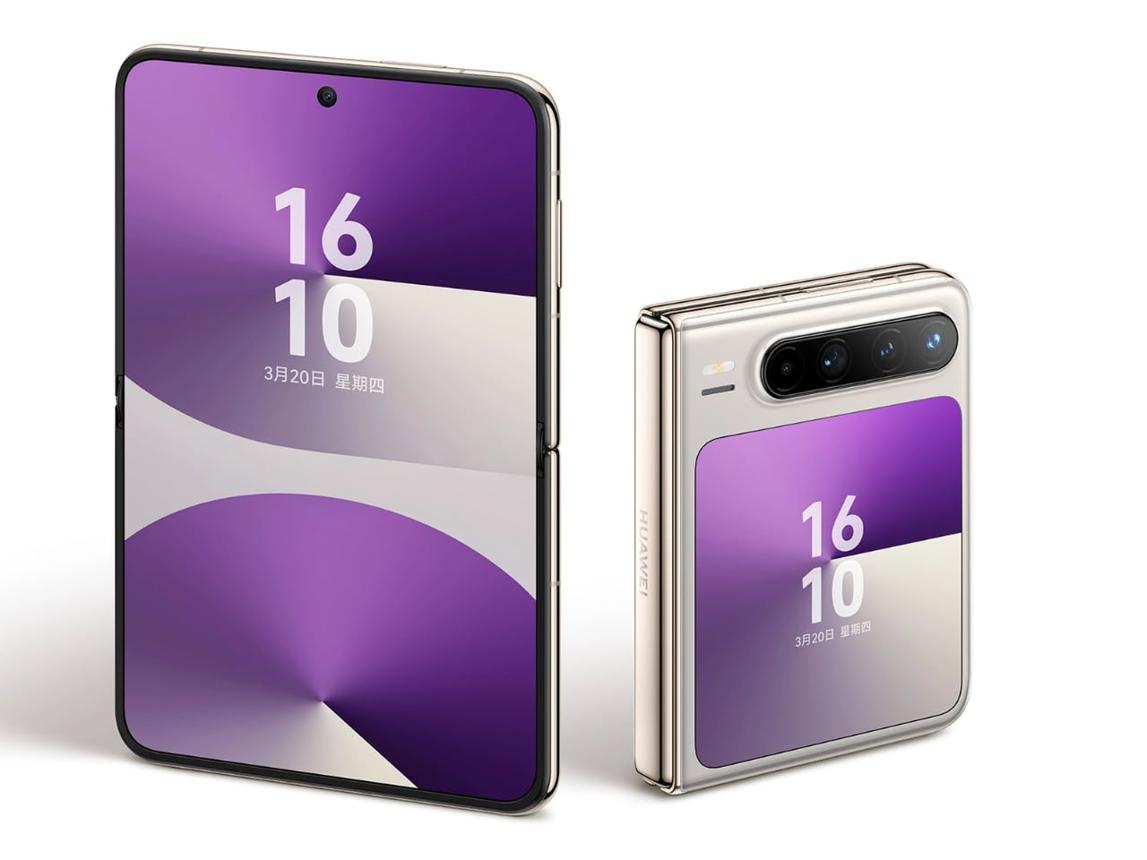
There is a moment in every product category where iteration gives way to redefinition. For foldable smartphones, that moment has largely been absent. Devices have become thinner, brighter and more durable, but the fundamental idea has remained intact: tall, narrow screens that unfold into slightly larger versions of themselves. With the arrival of the Huawei Pura X Max, that pattern begins to shift.
Rather than refining the established format, Huawei has approached the category from a different angle, quite literally. The Pura X Max introduces a wide, book-style foldable that feels closer to a compact tablet than an elongated phone, positioning itself as the first commercially available device to fully commit to this alternative form factor.
Rethinking the Shape of the Foldable
What immediately distinguishes the Pura X Max is its orientation. Instead of the tall, narrow silhouette seen across much of the current foldable market, Huawei has opted for a wider aspect ratio that resembles a passport when folded and a small tablet when opened.
The hardware supports that ambition. A 5.4-inch outer display delivers up to 3,500 nits of brightness, while unfolding the device reveals a 7.7-inch internal screen peaking at 3,000 nits, both supported by adaptive 1–120Hz LTPO refresh rates.
This is not just a cosmetic change. A wider display fundamentally alters how the device is used, making multitasking, reading and media consumption feel more natural, and less constrained by the vertical limitations that have defined earlier foldables. The design sits somewhere between a phone and a tablet, but unlike previous attempts, it appears intentionally optimised for both.
Performance, Power and the Huawei Ecosystem
Beneath the form factor, Huawei has equipped the device with its in-house Kirin 9030 Pro chipset, paired with configurations offering up to 16GB of RAM and 1TB of storage.
Battery capacity reaches 5,300mAh, supported by 66W wired and 50W wireless charging, ensuring that the larger display does not come at the expense of usability.
The device runs on HarmonyOS 6.1, reinforcing Huawei’s continued shift away from reliance on Android. This is more than a software decision; it reflects a broader strategy to build a self-contained ecosystem where hardware, software and AI capabilities are tightly integrated. Features such as stylus support and AI-driven photography enhancements, including automated pose suggestions, point towards a device designed as much for creation as consumption.
Imaging and Hardware Ambition

Huawei continues to lean heavily into imaging as a differentiator. The Pura X Max features a triple-camera system anchored by a 50MP main sensor with variable aperture, supported by a 50MP telephoto lens and a 12.5MP ultra-wide camera.
This configuration reflects a familiar Huawei philosophy: versatility over novelty. Rather than introducing experimental hardware, the focus is on refining core camera capabilities and pairing them with software enhancements driven by AI. The result is a system designed to adapt across scenarios, from low-light photography to long-range zoom.
Pricing, Positioning and Market Reality
The Pura X Max launches in China with a starting price of 10,999 yuan (approximately $1,600), rising to 13,999 yuan (around $2,050) for higher-end configurations.
This places it firmly within the premium segment, aligning it with flagship foldables from competitors. However, its positioning is less about price and more about timing. By bringing a wide-format foldable to market ahead of rivals, Huawei has effectively set the benchmark for what the next phase of the category could look like.
Global availability remains uncertain, with the launch currently limited to China, a reminder of the geopolitical and regulatory constraints that continue to shape Huawei’s international reach.
Beating the Market to Its Next Phase

What makes the Pura X Max significant is not just what it is, but when it arrives. Both Apple and Samsung are widely expected to explore similar wide-format foldables, but not until later in 2026.
That gives Huawei a rare advantage. Not necessarily in scale or global reach, but in narrative. For a company that has spent recent years navigating constraints, leading the next design shift in foldables represents a meaningful repositioning.
A Category Finally Moving Forward
The foldable market has long promised transformation, but often delivered refinement. The Huawei Pura X Max feels different because it challenges the underlying assumption of what a foldable should be.
By prioritising width over height, usability over familiarity, Huawei is not just releasing another device. It is testing whether the category is ready to evolve.
If the answer is yes, this may be remembered less as a product launch and more as the moment foldables finally found their direction.