


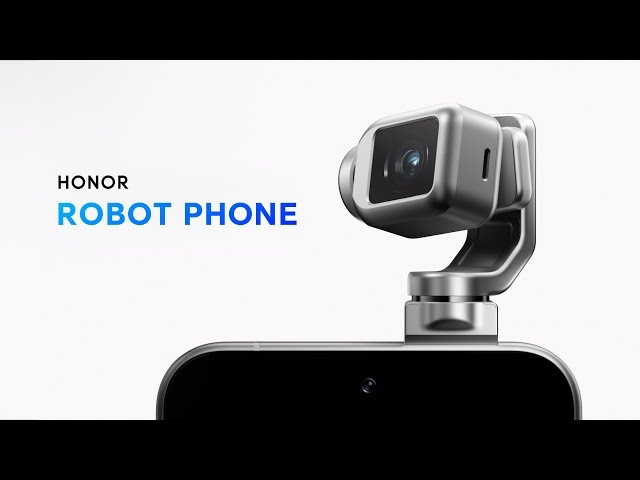
Honor is once again pushing the boundaries of mobile design with its upcoming Robot Phone, a concept device that blends futuristic mechanics with artificial intelligence. At the centre of its innovation lies a motorised pop-out camera arm that looks straight out of a sci-fi film — a feature that could transform mobile photography as we know it.

A Camera That Moves Like a Robot
Unlike the traditional pop-up or flip cameras seen in older designs, Honor’s new device features a mechanical gimbal arm capable of extending and rotating on its own. The arm houses the main camera, which can move independently, tracking subjects, shifting angles, and even rotating for high-quality selfies without the need for a separate front camera.
In demonstrations, the module behaves almost like a living companion — responding to prompts, pivoting to capture different perspectives, and even exhibiting subtle personality through motion cues. This marks one of the boldest attempts yet to blend robotics, AI, and mobile imaging.
Engineering Meets Expression
Honor’s goal with the Robot Phone is to explore how smartphones can become more intuitive and expressive. The brand describes the device as part of a wider strategy to make technology feel more human, interactive, and creative.
The camera’s robotic motion isn’t just a design flourish; it opens up new possibilities for hands-free photography, content creation, and autonomous tracking. Imagine setting your phone down while the camera automatically follows you through a video shoot, or rotates seamlessly to capture cinematic angles during live streaming.
It also raises an interesting design question: can movement and “personality” become part of the user experience? The playful design suggests that future smartphones may not simply respond to users — they may engage with them.
Pushing the Limits of Design
There are, of course, practical challenges. A moving mechanical arm adds complexity, weight, and power consumption — all major hurdles in a world that prizes slim, durable devices. The gimbal system must be robust enough to withstand daily use, yet compact enough to fit into a modern smartphone form factor.
Despite these obstacles, Honor’s concept signals a bold step forward in reimagining what mobile design can be. In a market dominated by incremental updates, this kind of mechanical creativity reintroduces the sense of wonder that once defined smartphone innovation.
What Comes Next
Honor is expected to launch the Robot Phone early next year, with more details to follow in the coming months. While it’s unclear whether this is a full production model or a showcase concept, the company’s message is clear: the next era of smartphones is about more than screens and specs — it’s about imagination and interaction.
Final Thought
If realised, the Honor Robot Phone could mark the beginning of a new design chapter for mobile devices — one where AI, robotics, and creativity converge. By turning a camera into a moving, intelligent feature rather than a static lens, Honor challenges the industry to think beyond the rectangle.
The result is a device that feels less like a phone and more like a companion — one that not only captures life’s moments but moves with them.