


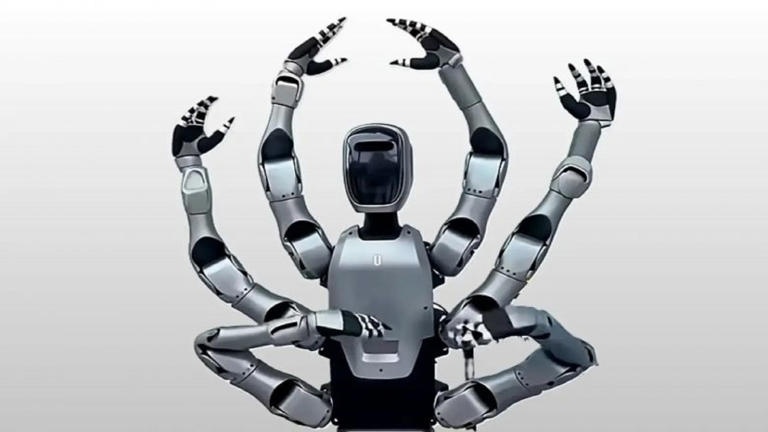
A new milestone in advanced robotics has been reached with the unveiling of the world’s first six-armed humanoid robot, a machine designed to push the boundaries of dexterity, efficiency and autonomous capability. Developed by researchers aiming to expand what humanoid robots can achieve, the six-limbed design represents a significant departure from the traditional two-armed humanoid form — and signals the beginning of a new era where robotic bodies are engineered not to mimic humans, but to surpass human physical limits.
Unlike conventional humanoids that prioritise human-like movement and ergonomics, this robot embraces a more functional, task-driven design philosophy. Its six coordinated arms allow for enhanced multitasking, complex manipulation and greater stability, enabling the machine to execute intricate operations that would be difficult or impossible for a robot built within the constraints of human anatomy.
A New Frontier in Robotic Dexterity
The six-arm configuration dramatically increases the robot’s operational versatility. Each arm can work independently or in synchronised groups, allowing the robot to:
- handle multiple tools simultaneously
- stabilise itself while performing precision tasks
- manage complex assembly procedures
- maintain balance while interacting dynamically with its environment
In industrial settings, this creates the potential for robots that can complete multi-step workflows without needing to switch tools or reposition, significantly improving efficiency and throughput.
Powered by Advanced AI
Behind the mechanical innovation is a powerful AI system capable of interpreting sensory input, planning actions and adjusting to changing conditions in real time. Machine-learning models enable the robot to understand and predict outcomes, making it far more adaptive than traditional automation platforms.
The robot’s AI brain allows for:
- autonomous decision-making
- precise coordination across all six arms
- continuous learning from performed tasks
- enhanced safety when working near humans
This combination of hardware and intelligence forms the foundation of a new generation of collaborative robots designed to coexist with human workers in complex environments.
Beyond Human Imitation
For decades, humanoid robots have been developed around the principle of human similarity — often with two legs, two arms and a head-like sensor array. The six-armed design breaks from this tradition by prioritising capability over mimicry.
The creators argue that robots should be optimised for useful performance rather than constrained by biological templates. In this case, additional arms offer clear advantages in balance, efficiency and task complexity, pushing robotics into new experimental territory.
Potential Applications Across Industries
The robot’s unique design opens possibilities across multiple sectors:
- Advanced manufacturing: performing precision assembly, tool switching and material handling simultaneously.
- Laboratory automation: conducting parallel tasks such as sample preparation, analysis and data capture.
- Logistics: managing complex sorting and packaging operations with higher throughput.
- Space and deep-sea exploration: maintaining stability in unstable environments while performing multi-tool tasks.
- Hazard response: handling dangerous materials with increased control and redundancy.
Its adaptability makes it a strong candidate for environments where human safety, efficiency and precision are critical.
A Glimpse into the Future of Robotics
The unveiling of the world’s first six-armed humanoid robot represents more than a technological achievement — it marks a philosophical shift in robotics. It demonstrates how the field is moving toward designs that extend human capability rather than simply replicate it.
As AI grows more sophisticated and mechanical innovation accelerates, future robots may increasingly feature forms optimised for performance rather than human likeness. The six-armed humanoid stands at the forefront of this evolution, offering a preview of the next generation of intelligent machines.