


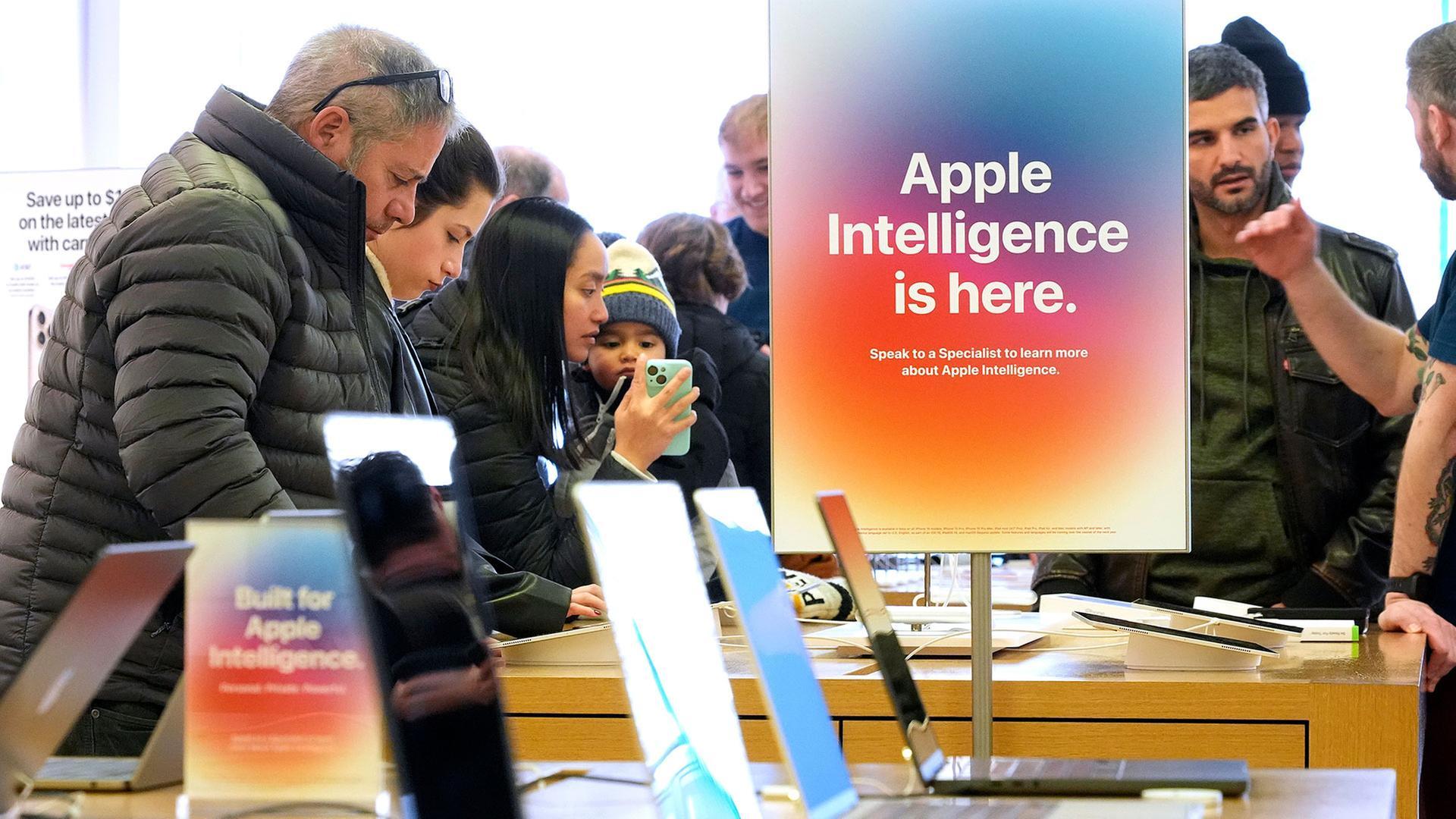
Apple is reportedly trialling technology that records, transcribes and summarises selected Genius Bar appointments, promising less administrative work for employees while raising fresh questions about customer consent, workplace monitoring and the growing presence of artificial intelligence in retail.
Apple is reportedly testing a new artificial intelligence tool capable of recording and summarising conversations between customers and employees during Genius Bar appointments.
Known internally as Live Notes, the pilot is said to be operating in a limited number of Apple Stores. During participating repair and technical-support sessions, the tool records the conversation, creates a written transcription and produces an AI-generated summary for the employee’s repair notes.
The technology is intended to reduce the amount of time Genius Bar employees spend manually documenting appointments, allowing them to concentrate more closely on the customer and the technical problem being discussed.
However, the trial also introduces sensitive questions about how recorded conversations are handled, whether employees could eventually be assessed through their transcripts and how comfortable customers will feel discussing personal devices while an AI system listens.
Apple has not publicly announced a broad rollout of Live Notes, and the information currently available comes from reporting on the limited internal pilot rather than a formal product launch.

How Live Notes reportedly works
During an eligible Genius Bar session, both the customer and the employee must reportedly agree before recording begins.
The audio is then converted into a transcript and summarised automatically. That summary becomes part of the repair-session record available on the employee’s work iPad, potentially replacing or reducing the manual notes normally completed during an appointment.
Apple reportedly says the original audio is not retained once the transcription process has been completed. Managers are also said to be unable to view the transcripts during the current pilot.
These safeguards are important because Genius Bar conversations may include more than a straightforward description of a broken screen or failing battery. Customers can discuss passwords, account access, personal photographs, communications, work documents and other information stored on their devices.
Even when the technical issue itself is relatively ordinary, the surrounding conversation can reveal sensitive details about a customer’s personal or professional life.
“The success of Live Notes will depend not only on the quality of its summaries, but on whether customers and employees trust the way those summaries are created and used.”
Apple already promotes the Genius Bar as a destination for one-to-one support, diagnostics and repairs using genuine parts. Customers are encouraged to back up their devices and prepare their account information before attending an appointment.
Introducing recording technology changes the character of that interaction. A conversation that previously disappeared once the employee completed a brief written report could now generate a much more detailed digital record.
Less paperwork and more attention
The operational argument for Live Notes is relatively clear.
Retail support employees must listen to the customer, inspect the device, run diagnostic tests, explain repair options and document the outcome. Completing those tasks accurately while maintaining a natural conversation can be difficult, particularly during busy periods.
Automatic transcription could allow an employee to remain more engaged instead of repeatedly looking down to type notes.
It could also improve consistency between appointments. A structured summary may capture symptoms, attempted troubleshooting steps and agreed next actions more reliably than hurried manual notes.
This may prove particularly useful when a repair continues across several employees or locations. A clear record could help the next technician understand what has already been discussed and avoid asking the customer to repeat the entire story.
Apple’s existing software already demonstrates the underlying technical concept. Voice Memos can generate transcripts, while Apple Intelligence can use Writing Tools to summarise recorded text.
Employee monitoring concerns
Although Live Notes is reportedly being presented as an employee productivity tool, some Apple Store workers are said to be concerned that the technology could eventually be used for performance monitoring.
A transcript could theoretically reveal how long an employee spent with a customer, which questions were asked, whether required procedures were followed and how repair options were communicated.
Even when managers cannot currently access the transcripts, employees may worry that the system’s purpose or access controls could change after a wider rollout.
This is part of a broader debate surrounding AI note-taking tools in the workplace. Automatic meeting assistants are increasingly being used to generate summaries, identify tasks and create searchable records of conversations that might previously have remained informal.
Such systems can improve productivity, but they may also change behaviour. Employees and customers may speak less freely when they know every word is being transcribed, even when the original audio is deleted.

Privacy will determine customer acceptance
Apple has built much of its corporate identity around privacy, meaning the company will face particularly close scrutiny should Live Notes expand.
For other voice-based services, Apple states that audio is not retained by default and that users must opt in before selected Siri and Dictation recordings can be stored and reviewed. The company also says participating data is linked to rotating identifiers rather than directly to an Apple Account.
Live Notes is a different system, but those existing policies demonstrate the level of transparency customers may expect.
Apple would need to explain clearly when recording starts, what information is retained, how long the summary remains attached to the repair record and who can access it.
Customers should also be able to decline without receiving a reduced standard of support.
Consent cannot be treated as a quick formality buried inside an appointment workflow. A customer must understand that the conversation will be transcribed and summarised before agreeing.
There is also the question of accuracy. AI summaries can omit context, misunderstand technical language or incorrectly attribute a statement. Employees would therefore need an opportunity to review and correct the generated notes before they become part of the repair record.
Bringing AI into the physical Apple Store
Live Notes illustrates how Apple Intelligence could extend beyond consumer features and into the company’s own operations.
Apple currently markets AI tools capable of summarising text, rewriting documents and processing spoken material across its devices. Bringing similar capabilities into the Genius Bar would turn those features into part of Apple’s retail infrastructure.
The trial could eventually influence other parts of the customer journey, including remote technical support, business consultations and product setup appointments.
A successful system might also help Apple identify recurring hardware and software problems more quickly by analysing patterns across support summaries.
However, this would increase the importance of data governance. Information gathered to document an individual repair should not automatically become a wider source of employee or customer analysis without additional transparency and consent.
A useful tool facing a significant trust test
Live Notes could make Genius Bar appointments more efficient and allow employees to offer customers their full attention.
Its advantages are easy to imagine: clearer repair histories, reduced paperwork and more consistent documentation across Apple’s retail network.
Yet the tool also sits at the intersection of two increasingly sensitive issues: AI-generated records and workplace surveillance.
Apple’s reported safeguards, including two-party consent, deletion of the audio and restricted managerial access, provide an important starting point. Whether those protections remain intact during any larger rollout will determine how the system is received.
For customers, the question will be whether Live Notes genuinely improves the appointment without making the experience feel invasive.
For employees, it will be whether the technology remains an assistant rather than becoming an evaluator.
Apple has not yet confirmed when, or whether, the programme will move beyond its limited trial. The experiment nevertheless offers a glimpse of how artificial intelligence may reshape customer service: not by replacing the person behind the counter, but by listening to the entire conversation.