


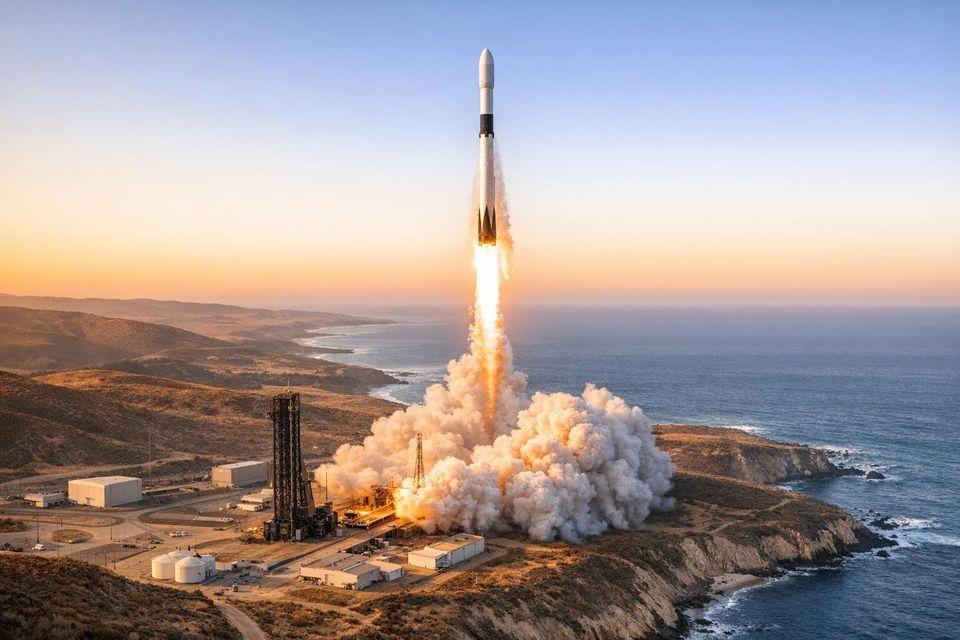
A Falcon 9 rocket carrying 24 Starlink satellites remained on the launch pad at Vandenberg Space Force Base after its engines shut down moments before liftoff. SpaceX is now preparing another attempt as it investigates the unusual interruption.
SpaceX is preparing to make another attempt to launch 24 Starlink broadband satellites from California after a rare last-second abort prevented its Falcon 9 rocket from leaving the ground.
The Starlink 17-39 mission had been scheduled to lift off from Space Launch Complex 4 East at Vandenberg Space Force Base on the morning of 20 July 2026. The countdown reached its final seconds and the rocket’s nine Merlin engines began firing, but an automatic shutdown was triggered before Falcon 9 was released from the pad.
The vehicle remained upright and appeared secure following the abort. SpaceX did not immediately provide a detailed explanation, although the company’s flight computers are designed to stop a launch automatically whenever sensor data falls outside established limits.
A new launch opportunity has been scheduled for 21 July at 7:43am Pacific Daylight Time, equivalent to 3:43pm in the UK. The timing remains subject to technical clearance, weather and range approval.
A launch stopped at the final moment
Launch teams regularly pause or delay missions before ignition, but an abort after the engines have started is comparatively unusual for Falcon 9.
The rocket uses a hold-down system that keeps the vehicle secured to the launch mount while its engines ignite and onboard computers verify that they are performing correctly. Falcon 9 is released only when the system determines that the engines, vehicle and ground equipment are ready for flight.
During the 20 July attempt, the engines fired but shut down before that release occurred. The launch commentator reported an abort as the countdown reached zero, leaving the rocket standing amid clouds of exhaust and water vapour.
Spaceflight Now reported that the last comparable Falcon 9 post-ignition abort occurred in June 2024 during preparations for the Starlink 10-2 mission. That flight eventually launched nine days later using a different first-stage booster.
“The abort demonstrates one of the least visible but most important parts of modern launch technology: the ability to stop safely when a problem appears only seconds before flight.”
An interrupted countdown does not necessarily indicate a serious or lasting failure. Launch vehicles monitor thousands of data points during ignition, and even a comparatively minor reading can stop the sequence until engineers understand its cause.
SpaceX will need to confirm that the rocket, engines and launch pad remain ready before proceeding with another attempt.
Twenty-four satellites waiting for orbit
The mission is intended to deploy another 24 Starlink V2 Mini satellites into low Earth orbit.
Starlink is SpaceX’s satellite internet network, created to provide broadband connectivity using a large constellation of spacecraft positioned much closer to Earth than traditional communications satellites.
Lower orbital altitude can reduce the delay between sending and receiving data, helping satellite connections support services such as video calls, streaming, online work and gaming.
The 24 spacecraft aboard Starlink 17-39 remain protected inside Falcon 9’s payload fairing while the company prepares for another attempt. After a successful launch, the rocket’s second stage would carry them into their initial orbit before releasing the satellites together.
Each spacecraft would then deploy its solar arrays and use onboard propulsion to move towards its intended operational position.
Recent deployment missions have expanded Starlink to more than 10,000 active satellites, making it the largest low Earth orbit communications constellation currently operating.
Another mission for a heavily reused booster
The Falcon 9 first stage assigned to Starlink 17-39 carries the identification number B1082.
This mission is scheduled to be the booster’s 23rd flight. Its previous assignments include national security missions, a OneWeb satellite launch and 19 earlier Starlink deployments.
Should the mission proceed successfully, the booster is expected to separate from the rocket’s upper stage before returning towards the Pacific Ocean. It will attempt to land vertically on the droneship Of Course I Still Love You.
Landing and reusing first stages has become central to the Falcon 9 business model. Instead of discarding the largest section of the rocket after one flight, SpaceX inspects, refurbishes and launches individual boosters repeatedly.
That process has helped the company maintain a launch schedule measured in multiple missions per week while reducing the amount of entirely new hardware required for every flight.
The original attempt was expected to become SpaceX’s 85th Falcon 9 mission of 2026 and the 667th Falcon 9 launch overall.

Vandenberg’s growing launch role
Vandenberg Space Force Base has become one of SpaceX’s most active launch locations.
Situated on California’s central coast, the base is particularly well positioned for missions travelling south over the Pacific Ocean. This allows rockets to reach high-inclination and polar orbits without flying over major populated areas.
Space Launch Complex 4 East has supported a growing number of Starlink, commercial and national security flights. On 16 July, just days before the interrupted Starlink countdown, SpaceX successfully launched 21 data-transport satellites from Vandenberg for the US Space Development Agency.
The coastal location also produces some of the company’s most visually striking launches. During clear evening or early-morning conditions, exhaust from the ascending rocket can remain illuminated by sunlight after the surrounding landscape has entered darkness.
However, the base’s position can introduce challenges including coastal fog, low cloud and strong upper-level winds. Each launch must also be coordinated with the US Space Force’s range teams, maritime exclusion areas and aviation authorities.
A second high-profile abort within days
The Falcon 9 interruption followed another last-second SpaceX abort only days earlier.
On 16 July, the company stopped the planned 13th test flight of its much larger Starship vehicle after an issue emerged during engine ignition at Starbase in Texas. SpaceX later determined that two Raptor engines would need to be replaced before the next attempt.
Falcon 9 and Starship are different vehicles with separate engines, launch systems and mission profiles. There is currently no public evidence that the two aborts were connected.
Nevertheless, the timing has drawn attention because SpaceX has built much of its reputation around an unusually high flight rate.
Falcon 9 remains the company’s operational workhorse, while Starship is being developed as a substantially larger fully reusable system intended to carry satellites, cargo and eventually people.
Starship is also expected to play a growing role in deploying larger next-generation Starlink V3 satellites. Its next test attempt is currently scheduled for 23 July.
Safety before schedule
Launch delays can carry financial and operational costs.
Satellites remain on the ground, launch teams must repeat preparations and droneships may need to stay at sea for longer than expected. A delayed mission can also affect later flights scheduled to use the same launch complex.
Yet the ability to stop safely remains more important than maintaining a timetable.
Falcon 9’s automated systems are intended to identify problems faster than a human launch team could react. The hold-down system ensures that a rocket is not committed to flight until its engines demonstrate acceptable performance.
For SpaceX, the next challenge is to determine whether the abort resulted from the rocket itself, supporting ground equipment or a sensor reading that can be resolved without extensive repairs.
The Starlink 17-39 mission therefore remains unfinished rather than failed. Its satellites are still aboard the rocket, the booster remains available and another opportunity has already been placed on the schedule.
Should Falcon 9 lift off successfully during the next window, the interruption will become another example of a launch system identifying a problem before it could affect the vehicle in flight.
For an industry built around controlled explosions and extreme precision, sometimes the most successful decision is the one that keeps the rocket on the ground.