


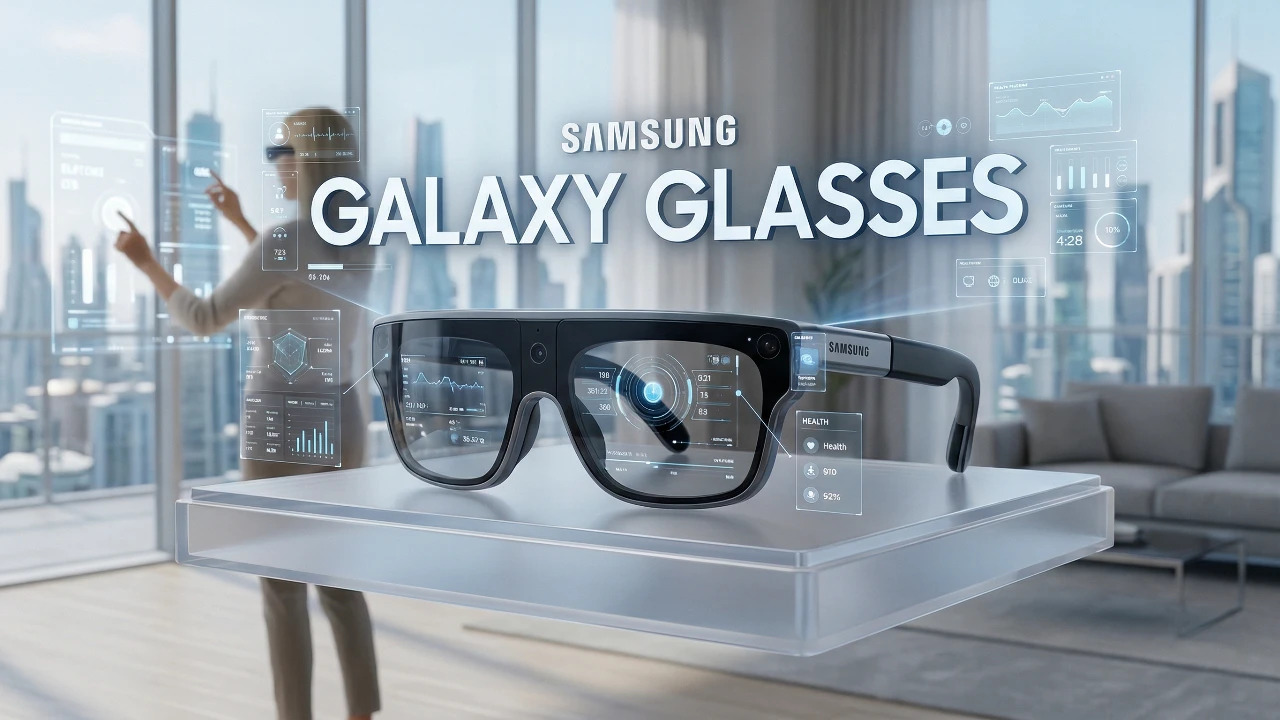
There is a noticeable restraint in how Samsung is approaching its upcoming Galaxy Glasses. In an industry often driven by spectacle, this feels deliberate. Rather than attempting to leap straight into fully immersive augmented reality, Samsung appears to be building something quieter, more considered — a device designed to integrate into daily life rather than interrupt it.
Expected to arrive in 2026, the Galaxy Glasses are being positioned not as a replacement for the smartphone, but as a subtle extension of it. The ambition is not to dazzle on day one, but to become useful enough, quickly enough, that they are worn without a second thought.
Function First, Not Futurism
At a hardware level, the device reflects that philosophy. Early details point to a 12MP camera, integrated microphones and speakers, and a lightweight build designed for all-day wear. Powered by Qualcomm’s AR1 chipset, the emphasis is on efficiency and responsiveness rather than raw processing power.
What stands out most is what has been intentionally left out. There is no full augmented reality display in this first iteration. Instead, Samsung appears to be prioritising reliability, comfort, and real-world usability — a foundation that can support more advanced features later.
It is a pragmatic beginning, and perhaps a necessary one.
A Different Kind of Interface
Where the Galaxy Glasses begin to distinguish themselves is in how users are expected to interact with them. The interface is not visual in the traditional sense. It is conversational.
Samsung is leaning heavily into AI as the primary layer of interaction, with voice-led commands and contextual awareness shaping the experience. Rather than navigating apps or screens, users will speak, listen, and receive information in real time. Translation, navigation, reminders, and communication become ambient rather than intentional actions.
It is less about adding another screen to your life, and more about removing the need for one.
Designed to Disappear

For a product like this to succeed, technical capability alone is not enough. It has to be wearable in the truest sense of the word.
Samsung’s reported collaborations with eyewear brands such as Gentle Monster and Warby Parker signal a clear understanding of that challenge. These are not intended to look like gadgets. They are intended to look like something you would choose to wear anyway.
That distinction matters. Previous generations of smart glasses often failed not because they lacked innovation, but because they never felt natural. Samsung seems intent on avoiding that mistake.
The Ecosystem Advantage

The Galaxy Glasses do not exist in isolation. They are part of a broader ecosystem play.
Built on Android XR, the device is expected to connect seamlessly with Samsung’s existing hardware — from smartphones and smartwatches to home devices and services. Notifications, music, calls, and navigation flow naturally between devices, reducing the need to constantly reach for a phone.
This is where Samsung holds a quiet advantage. The glasses are not just a product. They are another access point into an already mature ecosystem.
A Long-Term Play, Not a Launch Moment
What becomes clear, looking at the strategy as a whole, is that Samsung is not treating this as a single product launch. It is the opening move in a longer sequence.
The first generation is expected to focus on utility, AI integration, and behavioural adoption. A follow-up model, likely arriving later, is where more advanced augmented reality features will begin to appear.
That pacing feels intentional. Rather than asking users to immediately embrace a radically new interface, Samsung is introducing the concept gradually — building familiarity first, then expanding capability.
A Subtle Shift That Could Reshape Everything
The significance of the Galaxy Glasses is easy to underestimate. There is no dramatic unveiling of holograms or fully immersive environments. No attempt to redefine computing overnight.
But that may be precisely the point.
If successful, this kind of device does not need to replace the smartphone in a single moment. It simply needs to reduce reliance on it, interaction by interaction, until the shift feels natural.
And when that happens, it will not feel like a revolution. It will feel like something that was always meant to be there.