


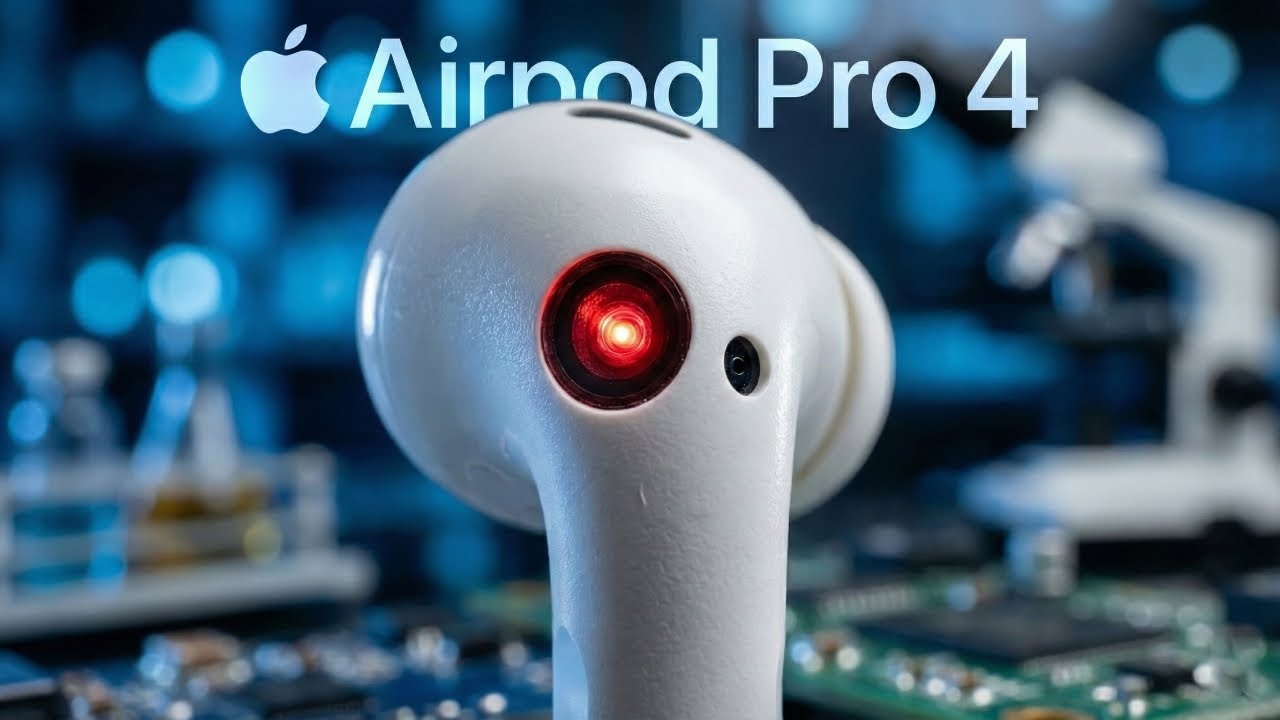
For years, Apple’s AirPods line has defined the mainstream wireless earbuds category — from the original AirPods to the ANC-equipped AirPods Pro. Now, as we move into 2026, early whispers about the next generation of AirPods Pro suggest Apple may be planning something truly disruptive: built-in cameras embedded in the earbuds themselves.
That’s right — the AirPods Pro 4 could be more than just an audio device. According to recent rumours and industry speculation, Apple is exploring the addition of micro camera sensors in the housings of the next AirPods Pro. While there’s no official confirmation yet, the potential implications are significant: imagine audio hardware that not only listens, but sees — opening the door to new interaction models, spatial awareness features and immersive mixed-reality experiences.
Why Cameras in Earbuds Matter
For most of the past decade, wireless earbuds have focused on three pillars:
- Audio quality (bass, clarity, fidelity)
- Noise cancellation (active and adaptive ANC)
- Comfort and connectivity
But adding cameras could extend that feature set dramatically.
With tiny sensors in each earbud, AirPods Pro 4 might be able to:
- Track head position or gestures
- Improve spatial audio calibration through visual context
- Interface with AR/VR systems for more intuitive control
- Enable novel interaction styles with apps (gaze-based, environment-aware)
These possibilities align with Apple’s broader work in spatial computing, hinted at in devices like Vision Pro and ongoing AR/VR initiatives.
How This Fits Apple’s Ecosystem
Adding cameras to AirPods Pro isn’t merely a hardware novelty — it could signal Apple’s intent to blur the boundaries between:
- Audio devices
- Spatial computing accessories
- Gesture and environment awareness tools
In recent years, Apple has steadily doubled down on spatial audio, immersive sound placement and head-tracked experiences across Music, Apple TV and gaming. Embedded cameras could give these experiences a new layer of contextual intelligence — learning from the user’s real-world environment and adjusting audio in real time.
For example:
- Earbud cameras could detect where you are (indoors vs outdoors) and tune ANC accordingly
- Tracking facial orientation could refine head-linked spatial audio for movies and games
- Visual inputs might power gesture controls — nod to advance track, raise hand to lower volume
This would put earbuds in a completely new category — hybrid sensory devices that interpret the world around you, not just the sound inside your ears.
Technical Challenges and Possibilities
Integrating camera sensors into something as small and sensitive as a truly wireless earbud would be a formidable engineering challenge. Apple would need to address:
- Power efficiency: Cameras and vision processing are energy-intensive
- Privacy and security: Cameras in always-on devices raise privacy questions
- Latency and processing: Visual data would need to be processed locally or via paired devices
Yet Apple has tackled similar frontiers before — from Face ID to LiDAR sensors — suggesting that if this is real, it may be closer to an integration challenge than an impossibility.
What Analysts Are Saying (So Far)
Industry analysts view these rumours through two primary lenses:
- Strategic foundation for future wearables: Some see camera-enabled earbuds as a stepping stone toward more immersive ecosystems blending audio, vision and spatial computing.
- Feature experimentation: Others caution Apple may simply be experimenting, and camera modules may not appear in retail products — at least not in 2026.
Neither view is definitive — but both agree that adding vision to audio hardware would mark a conceptual leap, not merely a spec bump.
When Might We See AirPods Pro 4?
Rumours currently pin Apple’s next AirPods Pro launch to the latter part of 2026 — potentially alongside an iPhone launch event in the fall. Apple’s history suggests that foundational platform changes (like camera integrations) would be rolled out only when software ecosystems are ready to support them — meaning native iOS support, frameworks for developers, and cross-device interoperability.
What This Could Mean for Users
If camera sensors truly make it into AirPods Pro 4, everyday experiences could change in subtle and surprising ways:
- Automatically adapt audio based on activity or surroundings
- Instant gesture controls for playback and communication
- New accessibility features for vision-assistance
- Next-gen fitness tracking combining audio, movement and visual context
Whether these features become mainstream or remain niche, the rumoured integration reflects Apple’s broad ambition: to craft devices that respond not just to touch, but to context.
Final Take: Vision for Audio?
At its core, this rumour isn’t about cameras in earbuds — it’s about new modes of interaction. For Apple, that has always been the playbook: push the envelope of what a category can do, not just what it currently does.
Until Apple confirms specifications, all of this remains speculative — but the implications are compelling. In a world where devices are increasingly aware of both sound and sight, AirPods Pro 4 could be the first leap toward audio hardware with real vision.