


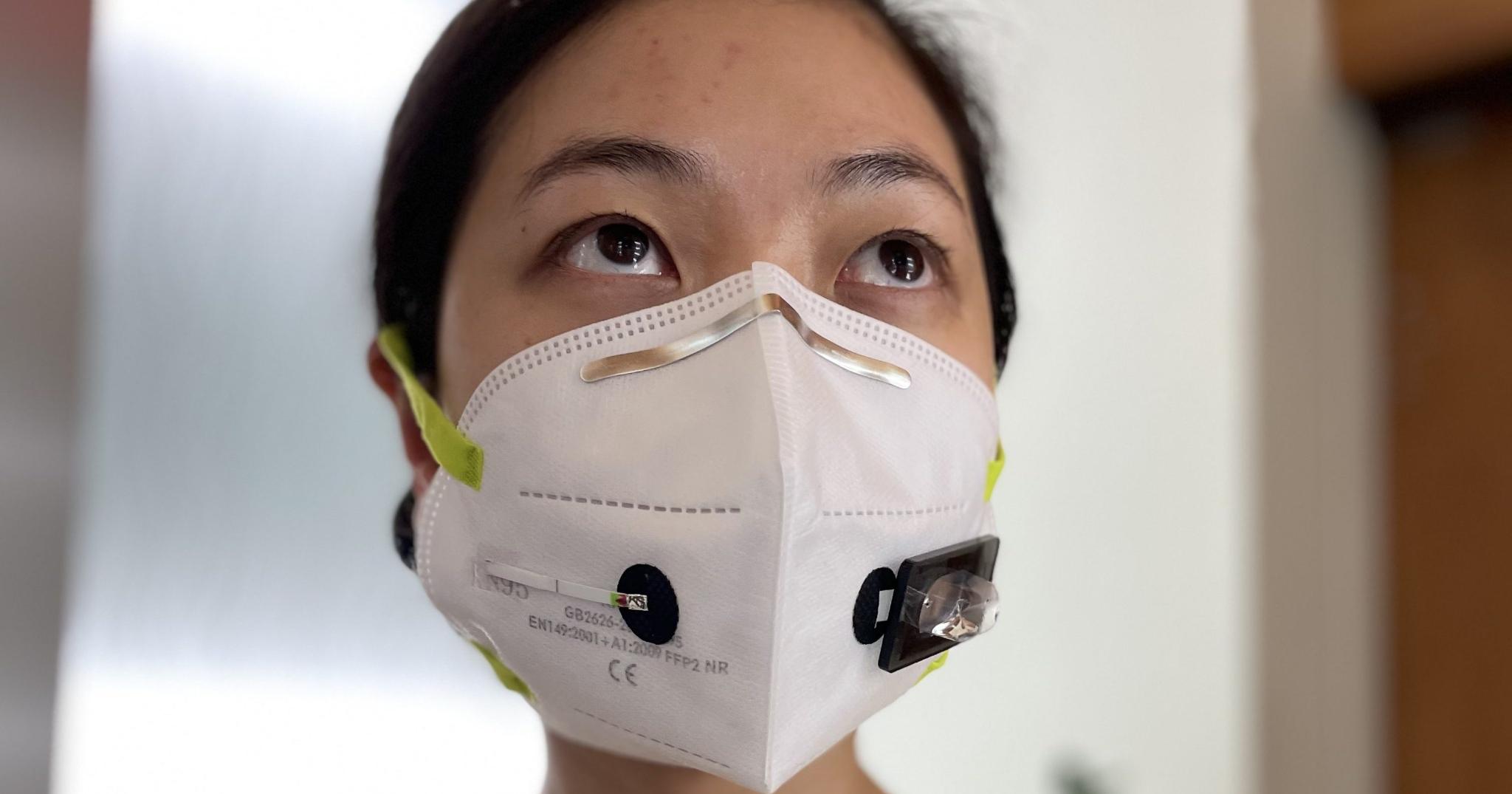
As the world continues to adapt to post-pandemic life, a team of researchers at MIT and the Wyss Institute has developed a prototype smart face mask capable of detecting COVID‑19 through wearers’ breath. This stealthy, wearable biosensor represents a major leap towards real-time, on-the-go health monitoring—complete with integrated detection, privacy, and pandemic preparedness.
How It Works
The smart mask embeds freeze-dried synthetic biology sensors (including CRISPR-based genetic circuits) into the mask’s fabric. When the wearer breathes, coughs, or speaks, any viral RNA in exhaled droplets reactivates these freeze-dried molecules. Within 90 minutes, the sensor triggers a fluorescent signal, visible only inside the mask, which can be interpreted using a portable fluorometer or smartphone interface
This mechanism was developed by Harvard and MIT scientists using a platform initially created for Ebola and Zika virus detection—and adapted stealthily to address COVID-era needs
Insights from the Researchers
Professor James Collins, head of the project, explains:
“We’ve demonstrated that we can freeze‑dry a broad range of synthetic biology sensors… We envision that this platform could enable next‑generation wearable biosensors for first responders, health care personnel, and military personnel.”
Co-author Dr Nina Donghia adds:
“This technology could be incorporated into lab coats… uniforms of first responders and military personnel who could be exposed to dangerous pathogens or toxins.”
Why This Matters
- Rapid Screening: This mask turns into a diagnostic device, delivering results within one to three hours—faster than many conventional lab tests
- User Privacy: Results are visually contained inside the mask or readable only by discreet devices, ensuring personal privacy .
- Modular Platform: The core tech—freeze-dried cell-free bio-sensors and aptamer/Crispr modules—can be reconfigured to detect other viruses or toxins
- Wearable Diagnostics: This marks a shift towards “lab-like” diagnostics worn on the body—integral to future outbreak monitoring or first responder readiness.
Tech Roadmap & Challenges
- Sensor miniaturization: Developing compact fluorescence readers or integrating low-cost smartphone adapters for in-mask scanning.
- Bio-ink fabrication: Ensuring consistent, shelf-stable sensor performance when embedded in textiles.
- Regulatory pathway: Establishing safety, sensitivity, and accuracy standards comparable to PCR testing.
- User adoption: Balancing convenience versus technical complexity; designing masks that users can don without expert training.
🚀 Future Possibilities
- Smart mask networks in high-risk environments—healthcare, transit hubs, or industrial plants—with instant pathogen alerts.
- Multi-target sensing: Adding layers for influenza, RSV, or toxin detection.
- Real-time data analytics: Anonymously aggregated diagnostics enabling public health systems to detect outbreaks earlier.
- Everyday health wearables: Personalized masks that monitor respiratory health, allergy triggers, or environmental quality.
TL;DR
- MIT & Wyss developed a mask with embedded freeze-dried CRISPR sensors that detect COVID RNA in breath in ~90 mins.
- It glows inside the mask; results are private and discreet.
- Modular design enables weaponizing diagnostic wearables for future outbreaks.
- Key challenges: integration of readers, bio-stability, regulation, and user ergonomics.
This is a milestone in wearable diagnostics—combining molecular biosensing with smart textiles.