


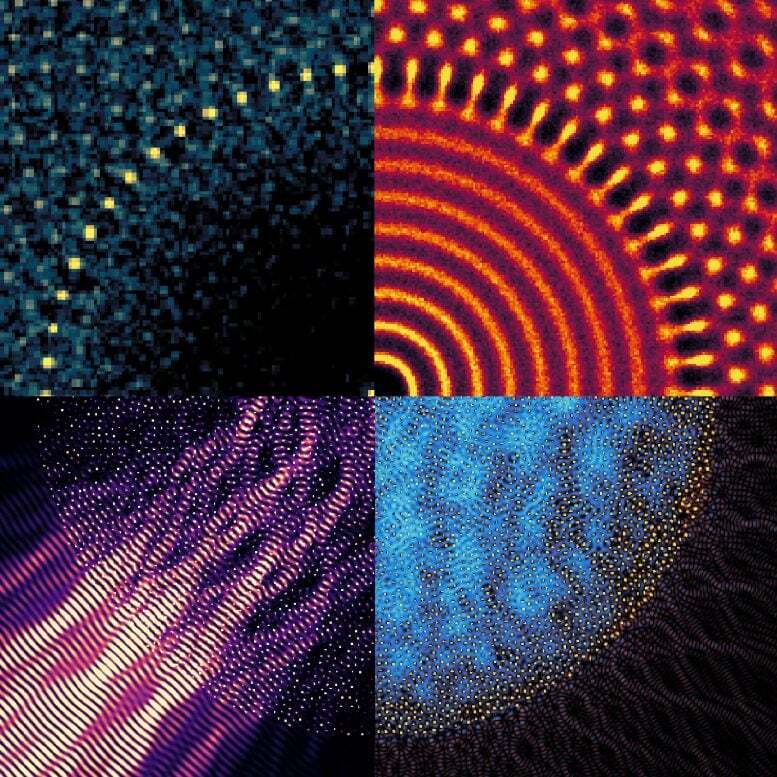
A newly engineered material is challenging long-held assumptions in physics and offering fresh momentum to the future of computing. Known as a gyromorph, this unusual hybrid structure could solve one of photonic computing’s biggest hurdles: how to efficiently control light at the nanoscale.
If successful, the development may bring light-based computing — long viewed as the successor to conventional electronic processors — significantly closer to real-world deployment.
What Makes This Material Different
Gyromorphs are neither fully ordered like traditional crystals nor completely random like amorphous materials. Instead, they occupy a middle ground — deliberately blending order and disorder in a carefully controlled way.
This structural hybrid creates a rare and highly valuable property: an isotropic photonic bandgap. In simple terms, the material can block or confine light equally in all directions. That is a major breakthrough, as most existing photonic materials struggle to control light without directional leakage or signal loss.
By solving this issue, gyromorphs allow light to be trapped, guided and manipulated with far greater precision inside extremely small volumes.
Why This Matters for Computing
Conventional computers rely on electrons flowing through transistors. While effective, electronic computing is increasingly limited by heat, power consumption and physical scaling.
Photonic computing replaces electrons with photons — particles of light — which can travel faster, generate far less heat and potentially enable dramatic gains in speed and energy efficiency.
However, controlling light inside tiny circuits has proven difficult. Light naturally scatters and escapes, making it hard to miniaturise photonic components the way electronic chips have been miniaturised.
Gyromorphs directly target this problem. Their ability to tightly confine light could enable:
- Faster data processing
- Lower energy consumption
- Denser chip architectures
- Reduced heat generation
In effect, they offer a new foundation for building compact, high-performance photonic chips.
How the Breakthrough Was Achieved
Rather than aiming for perfect symmetry or complete randomness, researchers explored what happens when correlated disorder is introduced at the microscopic level. Using advanced modelling, they demonstrated that carefully tuned irregularity can outperform traditional ordered structures in controlling light.
This insight challenges decades of materials science, where order was assumed to be essential for predictability and performance. Gyromorphs demonstrate that controlled disorder can be just as powerful — if not more so.
Potential Applications Beyond Computing
While photonic computing is the most attention-grabbing application, the implications extend further. Materials with strong light-confinement properties could also influence:
- Optical communications and data transmission
- Laser systems and photonic sensors
- Quantum technologies
- Advanced imaging and spectroscopy
In each case, improved control over light at small scales unlocks new capabilities.
What Still Stands in the Way
Despite its promise, the gyromorph remains a research-stage material. Significant challenges must be addressed before commercial adoption becomes feasible:
- Integrating the material into existing chip-fabrication processes
- Scaling production with consistent quality
- Demonstrating stability and reliability over long operating periods
- Interfacing photonic components with conventional electronic systems
Researchers describe the discovery as a critical step forward — not a finished solution.
Conclusion
Gyromorphs represent a shift in how scientists think about materials, order and control at the nanoscale. By turning a blend of order and disorder into an advantage, this hybrid material could help unlock the long-anticipated potential of photonic computing.
If future development succeeds, gyromorphs may form the backbone of faster, cooler and more energy-efficient computers — reshaping how information is processed in the decades ahead.