


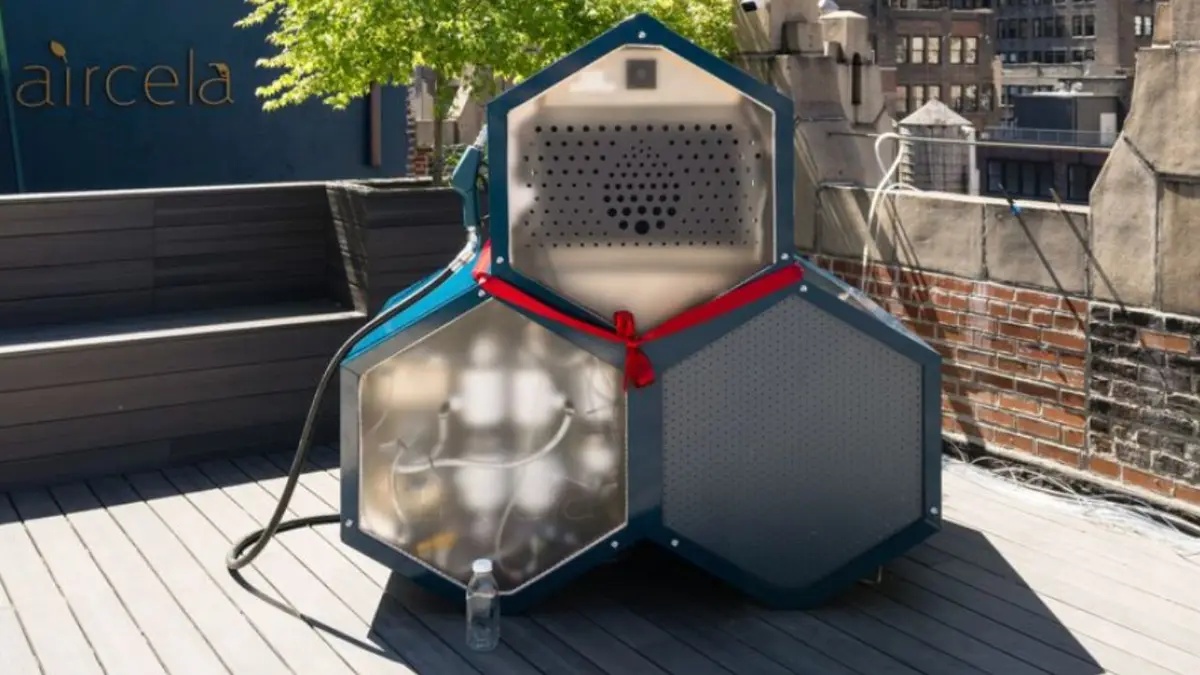
A startup in New York has unveiled a groundbreaking device that appears to turn ordinary air into usable gasoline, without drilling or extracting fossil fuels — a development that could reshape conversations about energy, climate tech and mobility.
The technology, developed by fuel-tech company Aircela Inc., uses direct air capture (DAC) combined with renewable electricity to pull carbon dioxide (CO₂) from the atmosphere, blend it with hydrogen produced on-site from water, and convert these elements into motor-grade gasoline. The result: a drop-in synthetic fuel that can run in any conventional internal-combustion engine.
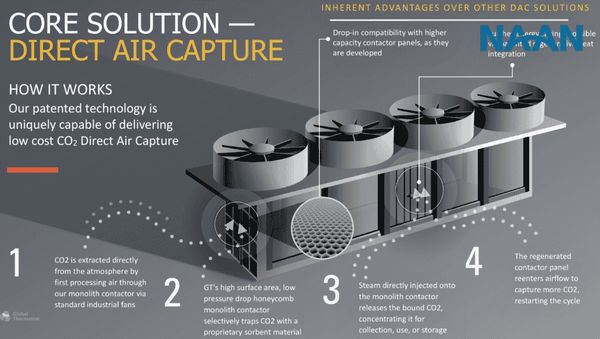
How the Technology Works
The process is complex in chemistry but elegant in concept:
- Direct Air Capture: The machine sucks in ambient air and pulls CO₂ out of it using a chemical sorbent.
- Hydrogen Production: Water is split into hydrogen and oxygen using renewable electricity.
- Fuel Synthesis: The captured carbon and hydrogen are combined to produce methanol, which is then further converted into true gasoline via established methanol-to-gasoline (MTG) chemistry.
Unlike biofuels made from crops or waste, this fuel relies solely on air and water as raw inputs, meaning it does not compete with food resources or cropland. And because the carbon it releases on combustion is the same carbon captured from the atmosphere, the overall process is touted as net-zero carbon — so long as the electricity comes from renewable sources.
Not Quite Magic — But Close
The machine is roughly the size of a commercial refrigerator yet can produce around one gallon of gasoline per day under continuous operation. That’s not enough to fuel the average car for daily commuting, but as a proof-of-concept it showcases a real-world application of carbon capture and fuel synthesis.
According to demonstrations and company statements:
- The fuel produced contains no sulfur, ethanol or heavy metals, and meets motor-grade standards.
- The machine can store up to 17 gallons internally.
- It is fully compatible with existing engines and fuel infrastructure.
Critics note, however, that producing a single gallon still requires significant energy — roughly 75 kWh per gallon — and so the overall efficiency remains low compared with direct electrification or conventional fuels. But when paired with renewable energy like solar or wind, the system’s operating cost could be economically competitive with retail gasoline, especially in isolated or off-grid applications.
A Real-World Demonstration
Last year, Aircela publicly demonstrated the machine on a rooftop in New York City, showing it operating in real time and producing gasoline right on site.
While the fuel-from-air concept may sound like science fiction, each individual step — from direct air capture to methanol synthesis and MTG fuel conversion — is based on well-established chemical engineering principles that have been studied and implemented at industrial scales for years.
Realistic Potential and Challenges
While the idea of making gasoline out of air captures the imagination, experts caution that the technology is currently small-scale and energy-intensive. Producing significant amounts of liquid fuel — enough to power fleets or entire regions — would require vast arrays of machines and equally massive supplies of cheap renewable electricity.
Moreover, while the process is carbon-neutral from a fuel-production standpoint, it does not address all emissions associated with traditional vehicle use — including non-CO₂ pollutants and the broader lifecycle impacts of combustion engines versus electrification.
Still, for certain use cases — such as powering small fleets, remote generators, vintage vehicles, aircraft or equipment where electrification is difficult — gas-from-air technology represents a compelling complement to the energy transition.
Looking Ahead
Aircela plans to begin limited commercial sales by late 2026, targeting both residential and specialised industrial customers. The initial cost per unit could range in the tens of thousands of dollars, though the company hopes economies of scale will bring prices down over time.
Whether this innovation becomes a mainstream energy solution or remains a niche technology, its emergence highlights a broader shift in how engineers and entrepreneurs are rethinking fuel — not just as a product extracted from the earth, but as something that might one day be synthesised sustainably from the very air we breathe.