


The AI arms race has largely been defined by scale. Massive data centres, hyperscale cloud infrastructure and multi-billion-dollar investments have become the foundation of modern artificial intelligence. Yet as enterprises push AI deeper into everyday operations, a new challenge has emerged: how do organisations bring frontier-level AI performance directly into the environments where employees actually work?
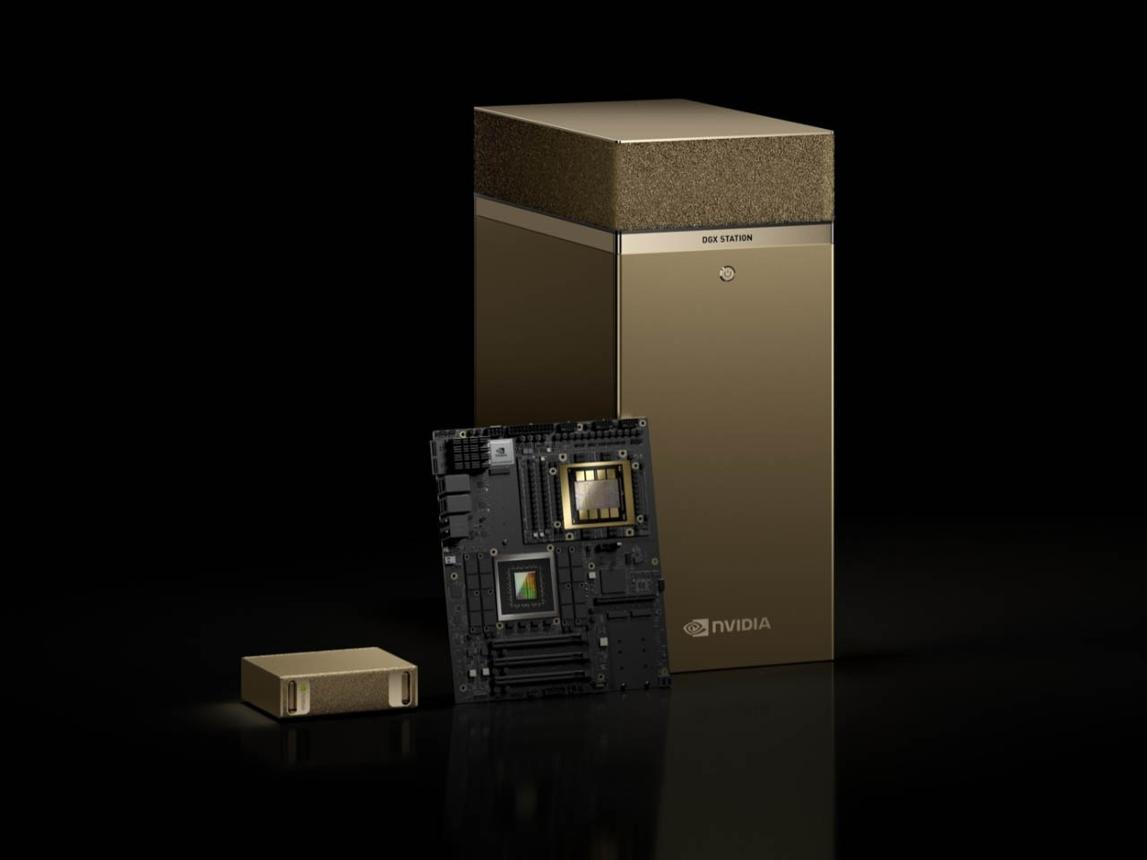
That question sits at the centre of NVIDIA’s latest announcement. With the unveiling of the new DGX Station for Windows, the company is attempting to bridge the gap between enterprise desktops and the kind of computational power that has traditionally existed only inside advanced AI facilities.

According to NVIDIA, the new system is capable of running AI models with up to one trillion parameters locally, bringing a level of performance previously associated with cloud-scale infrastructure into a deskside workstation. The announcement marks another step in the company’s broader strategy to move AI development closer to enterprise users, allowing developers, engineers, researchers and data scientists to work with increasingly sophisticated models without relying entirely on remote computing environments.
The significance of that shift goes beyond raw processing power. For years, enterprise software ecosystems have largely been built around Windows environments, while advanced AI development has traditionally been centred on Linux-based infrastructure. NVIDIA’s new platform aims to remove that divide, enabling organisations to build, test and deploy advanced AI systems directly inside existing Windows workflows.
At the heart of the system is the NVIDIA GB300 Grace Blackwell Ultra Desktop Superchip, combining a powerful Blackwell Ultra GPU with a 72-core Grace CPU connected through NVIDIA’s NVLink-C2C architecture. The result is a system designed to deliver the kind of communication speeds and memory bandwidth required by modern AI workloads. NVIDIA says the platform can deliver up to 20 petaflops of FP4 performance while offering up to 748GB of coherent memory.
That memory capacity is particularly important in the age of large language models. One of the biggest challenges facing AI developers today is moving massive datasets between processors, memory and storage. By dramatically increasing local memory availability, NVIDIA is attempting to reduce those bottlenecks and allow larger models to run directly on local hardware.
The company is positioning the DGX Station as more than just another workstation. Instead, it is presenting the platform as dedicated infrastructure for the next generation of autonomous AI agents.
The conversation around AI has shifted noticeably over the past year. Enterprises are increasingly moving beyond chatbot interfaces and toward agentic systems capable of performing tasks independently, interacting with applications and managing complex workflows with minimal human intervention. NVIDIA believes these always-on agents will become a core component of enterprise operations, and the DGX Station is being designed specifically to support that transition.
Chris Marriott, Vice President of Enterprise Platforms at NVIDIA, described the platform as infrastructure that can connect directly to the applications and workflows businesses already depend on. Meanwhile, Microsoft sees the collaboration as an extension of decades of partnership between the two technology companies, bringing data-centre-class AI capabilities directly into the Windows ecosystem.

One of the more interesting aspects of the announcement is NVIDIA OpenShell, an open-source runtime environment designed specifically for autonomous AI agents.
As organisations begin deploying AI systems capable of accessing applications, files and business processes, security concerns naturally become more significant. OpenShell is designed to create isolated environments for each AI agent, separating application-level operations from infrastructure-level security controls. NVIDIA says this approach allows enterprises to apply security policies at the system level rather than relying solely on behavioural restrictions embedded within AI prompts.
This security-first approach reflects a growing reality across enterprise AI adoption. The challenge is no longer simply building powerful models. It is ensuring those models can operate safely inside environments containing sensitive business data, intellectual property and operational systems.
Beyond agent development, NVIDIA is positioning the DGX Station as a platform capable of supporting virtually every major enterprise AI workflow. That includes model pretraining, fine-tuning, inference, machine learning, analytics and physical AI simulations. The system can also be paired with an NVIDIA RTX PRO 6000 Blackwell Workstation GPU, allowing users to combine AI processing with advanced visualisation and simulation capabilities.
For industries such as manufacturing, engineering, robotics and product design, that combination could prove particularly valuable. Physical AI systems increasingly require environments where models can perceive, simulate and interact with virtual worlds before being deployed into real-world scenarios. NVIDIA sees deskside AI infrastructure as a way to accelerate that process.
The timing of the announcement is also notable.
Over the past two years, the AI industry has largely focused on centralised compute power. Cloud providers, hyperscalers and large-scale AI factories have dominated investment conversations. NVIDIA’s latest move suggests the company sees significant opportunity at the opposite end of the spectrum as well.
Rather than replacing cloud infrastructure, systems like DGX Station appear designed to complement it. Developers can build locally, iterate rapidly and then scale workloads into larger data-centre environments when necessary. NVIDIA explicitly describes the workstation as a bridge between local development and enterprise-scale deployment.
The broader vision is clear. As AI becomes integrated into everyday business operations, access to powerful computing resources may need to become more distributed. Not every organisation will want every workload running through external cloud environments, particularly when concerns around latency, security, compliance and intellectual property remain high priorities.
That is where the concept of a personal AI supercomputer becomes increasingly compelling.
While the phrase may sound ambitious, it aligns with a larger trend emerging across the industry. NVIDIA has already introduced smaller AI-focused desktop systems such as DGX Spark, which can run models with up to 200 billion parameters locally. The DGX Station dramatically expands those capabilities, pushing performance into territory previously reserved for advanced AI laboratories and hyperscale infrastructure.
The result is a vision of enterprise computing that looks very different from the traditional workstation model. Instead of simply running applications, future workstations may become intelligent AI hubs capable of hosting multiple autonomous agents, training custom models and performing advanced reasoning tasks entirely on-premises.
Whether organisations are ready for trillion-parameter AI at the desktop level remains to be seen. Cost, deployment complexity and practical use cases will all influence adoption. However, the direction of travel is becoming increasingly clear.
The future of enterprise AI may not be defined solely by massive server farms hidden inside data centres. It may also be shaped by the machines sitting directly beside the people building, designing, analysing and creating every day.
With DGX Station for Windows, NVIDIA is making a strong argument that the next phase of AI computing belongs on the desk.