


AMD has surpassed a market valuation of US$1 trillion for the first time, marking a major milestone for the chipmaker as demand for artificial intelligence infrastructure continues to reshape the global semiconductor industry.
Shares in Advanced Micro Devices rose sharply on 21 September, pushing the company into the trillion-dollar valuation club alongside other major US chipmakers.
The rise reflects growing investor confidence in AMD’s expanding role across AI computing, data centres and high-performance infrastructure, as the company moves beyond standalone processors towards complete AI systems combining GPUs, CPUs, networking and software.
From Chips to Complete AI Systems
AMD’s growth strategy has increasingly focused on supplying the full technology stack required to build and operate large-scale artificial intelligence infrastructure.
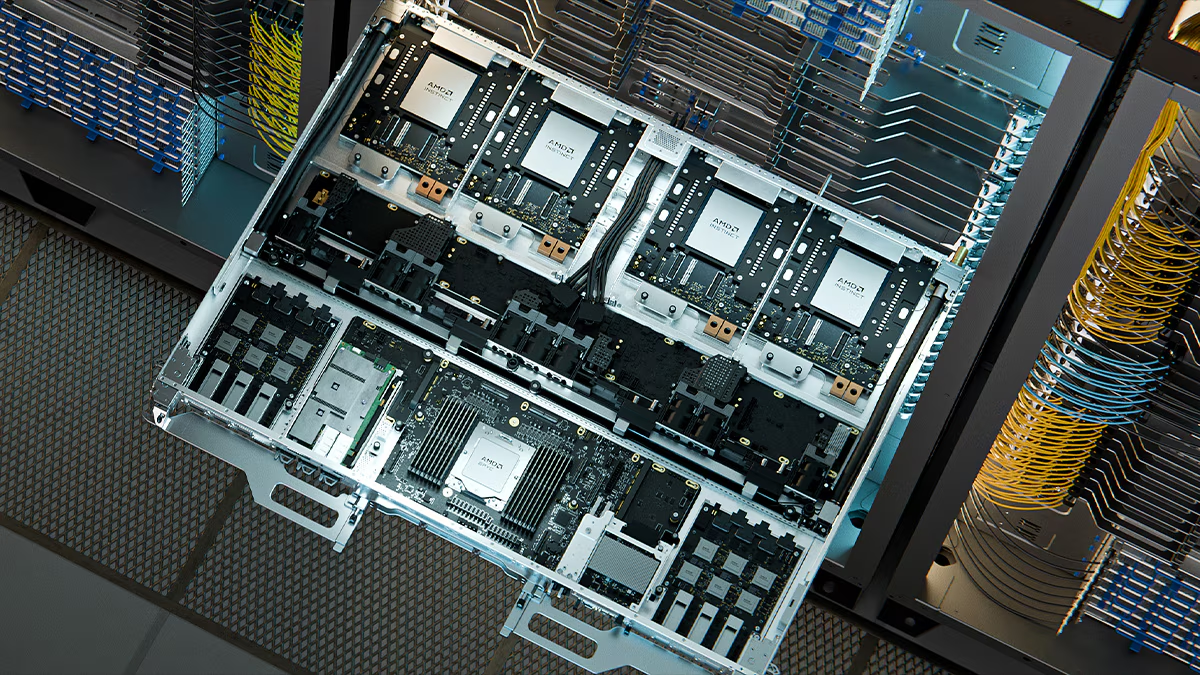
The company’s Instinct accelerator portfolio now sits at the centre of that strategy, supported by EPYC server processors, Pensando networking technology and AMD’s ROCm software ecosystem.
Its Helios rack-scale platform brings those technologies together into an integrated AI infrastructure system designed for large-scale training and inference.
AMD says Helios combines GPUs, CPUs, networking and open software into a unified rack-level architecture aimed at hyperscale AI workloads.
That shift is significant because the next phase of AI investment is increasingly being driven by complete systems rather than individual chips.
Data-centre operators and technology companies are seeking platforms that can integrate computing, memory, networking, power and software at enormous scale.
“AMD’s trillion-dollar milestone shows how the AI boom is increasingly becoming an infrastructure story.”
Major AI Companies Back AMD
AMD has already secured commitments from several of the world’s largest technology companies.
The company says OpenAI and Meta have committed to AI infrastructure deployments of up to six gigawatts, while Anthropic has announced plans for up to two gigawatts of AMD-powered infrastructure.
Microsoft is also bringing AMD’s Helios platform to Azure, while Oracle plans to deploy 50,000 AMD Instinct GPUs during 2026 before expanding further in 2027.
AMD and Anthropic announced a separate strategic partnership in July that will see the AI company deploy up to two gigawatts of MI450-series GPUs, with the first gigawatt scheduled to begin deployment in the first half of 2027.
AMD also committed to invest up to US$5 billion in Anthropic as part of the agreement.
AI Demand Reshapes the Semiconductor Market
The expansion of generative and agentic AI has created enormous demand for data-centre computing power.
Training increasingly sophisticated models requires large numbers of specialised accelerators, while the rapid growth of AI inference means computing demand continues even after those models have been deployed.
That has created opportunities for semiconductor manufacturers capable of supplying scalable alternatives to the industry’s dominant AI platforms.
AMD has been positioning its Instinct product family as one of those alternatives.
The company recently reported its broadest-ever submission to the MLPerf Inference benchmarking programme, covering six model families across its MI350-series GPUs.
AMD also said a system powered by 512 of its GPUs achieved the highest aggregate token throughput submitted to MLPerf at the time.
A Broader Technology Opportunity
AMD’s ambitions extend beyond hyperscale data centres.
At its Advancing AI 2026 event, the company introduced products spanning data-centre infrastructure, embedded computing, robotics and physical AI.
AMD estimates that demand across the wider computing market it serves could represent an addressable opportunity of approximately US$2 trillion by 2030.
The company is also working with customers and partners across cloud computing, sovereign AI and enterprise deployments as organisations seek greater choice in the technologies powering their AI infrastructure.
That broader strategy is helping transform AMD from a company historically associated primarily with PC processors into one of the central players in the global race to build AI computing capacity.
A Milestone in the AI Infrastructure Boom
AMD’s trillion-dollar valuation provides another indication of how dramatically artificial intelligence is reshaping the technology sector.
The beneficiaries of the AI boom are no longer limited to companies developing models and applications.
Semiconductor manufacturers, networking providers, data-centre operators and infrastructure suppliers are increasingly becoming central to the industry’s growth.
For AMD, the milestone reflects growing expectations that its combination of CPUs, GPUs, networking and open software can play a larger role in that market.
As AI infrastructure investment continues to expand, competition over the technology powering the world’s data centres is likely to remain one of the defining battles of the technology industry.