


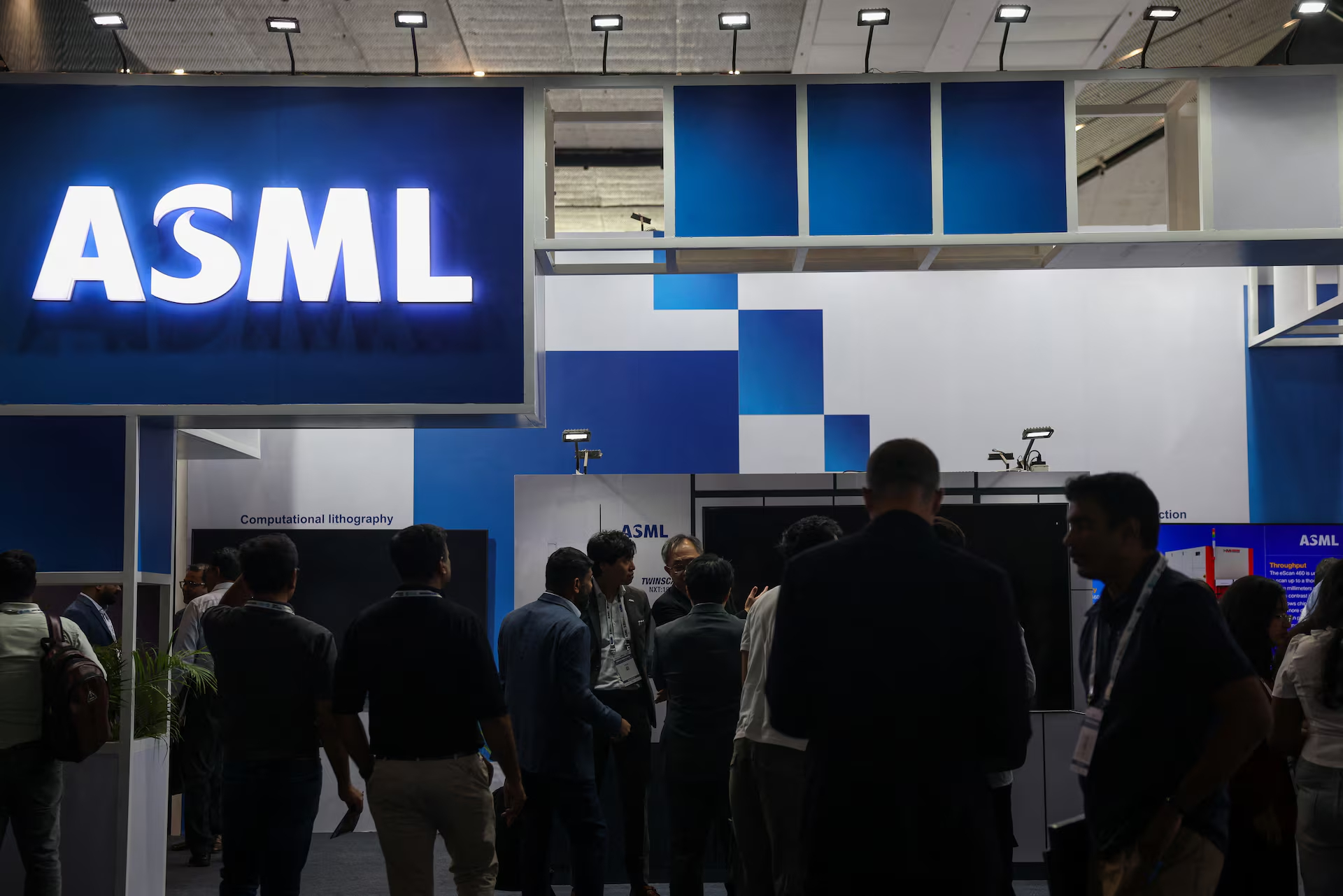
ASML has raised its full-year outlook after reporting record third-quarter sales, as demand for the advanced semiconductor manufacturing equipment required to power artificial intelligence continues to accelerate.
The Dutch technology company recorded net sales of €11.7 billion during the third quarter of 2026, alongside net income of €5.0 billion and a gross margin of 57.5 per cent.
The performance represented a significant increase on the previous quarter, when ASML generated sales of €9.3 billion and net income of €2.9 billion.
Strong demand has prompted the company to increase its full-year sales forecast to between €44 billion and €45 billion, with a gross margin expected to reach approximately 56 per cent.
AI Investment Drives Equipment Demand
ASML sits at a critical point within the global semiconductor supply chain.
Its lithography systems are used by major chip manufacturers to produce increasingly advanced processors, including the chips required for artificial intelligence, data centres and high-performance computing.
As investment in AI infrastructure continues to expand, semiconductor manufacturers are increasing plans for new production capacity.
ASML Chief Executive Christophe Fouquet said customers had continued to increase their short- and medium-term equipment demand forecasts, driven primarily by expectations around the size and duration of AI-related investment.
The company said some customers are already expressing interest in placing orders for equipment that would not be delivered until 2029 or even 2030.
That level of forward visibility highlights the extraordinary scale of investment taking place across the semiconductor industry.
“The challenge for ASML is increasingly not finding demand, but producing enough equipment to satisfy it.”
Capacity Could Struggle to Keep Pace
Demand is now becoming so strong that ASML expects its planned manufacturing capacity for both 2027 and 2028 may not be sufficient to meet customer requirements.
The company had already outlined plans to increase production capacity for its low numerical aperture EUV and DUV immersion systems by around 30 per cent in 2027.
A further increase had been planned for 2028.
ASML is now examining ways to expand capacity beyond those earlier targets as customers accelerate spending plans.
The company is also improving the productivity of existing systems already installed at customer sites, helping chipmakers increase wafer output without relying solely on new machines.
Record Sales Across the Business
ASML sold 113 new lithography systems during the quarter, compared with 86 in the previous three months.
Installed Base Management sales, which include service and upgrades for existing systems, reached €3.3 billion and came in ahead of company expectations.
The strength of that business demonstrates the growing importance of improving the performance of existing semiconductor factories as manufacturers seek additional output.
For the fourth quarter, ASML expects revenue of between €14.2 billion and €15.2 billion, with a gross margin of approximately 57 per cent.
If achieved, that would bring full-year revenue to the company’s revised €44 billion to €45 billion range.
The Infrastructure Behind Artificial Intelligence
The results provide another indication that the artificial intelligence boom is increasingly an infrastructure story.
While much of the attention surrounding AI has focused on models and software platforms, the industry ultimately depends on a complex physical supply chain spanning chips, manufacturing equipment, data centres, networking and power.
ASML occupies one of the most strategically important positions within that chain.
Its extreme ultraviolet lithography systems allow chipmakers to manufacture some of the world’s most advanced semiconductors by projecting highly precise patterns onto silicon wafers.
Those chips subsequently power AI accelerators, smartphones, servers and other advanced computing systems.
As AI models become larger and demand for inference continues to grow, semiconductor manufacturers need considerably more advanced computing capacity.
That dynamic is translating directly into higher equipment demand.
Semiconductor Investment Looks Further Ahead
Perhaps the clearest indication of the industry’s confidence is how far into the future customers are now planning.
Interest in equipment deliveries stretching into 2029 and 2030 suggests chip manufacturers expect demand for advanced computing infrastructure to remain significant for years rather than quarters.
Reuters reported that customers including TSMC, Samsung, SK Hynix, Micron and Intel are among companies expanding semiconductor capacity as AI investment accelerates.
That expansion is creating opportunities throughout the semiconductor ecosystem, from manufacturing equipment and memory technology to advanced packaging and data-centre infrastructure.
For ASML, the challenge is increasingly not generating demand, but producing enough machines to satisfy it.
With record quarterly sales, a raised full-year outlook and customers planning investments several years in advance, the company’s latest results offer one of the clearest signals yet that global AI infrastructure investment remains firmly in expansion mode.